Photo: CCHG
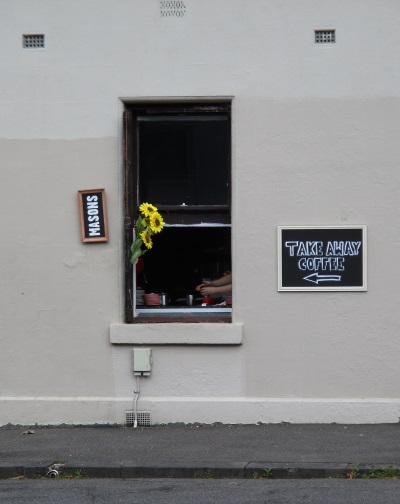
Coffee Serving Window at Masons
Corner of Rathdowne and O'Grady Streets, North Carlton
|
The Side Window
While not as famous as the "rear window" of Alfred Hitchcock's classic film of 1954, the side window of 344 Rathdowne Street, with its distinctive grille, has its own place in cinematic history.
The two-storey building, on the corner of O'Grady Street, North Carlton, was once the home and studio of photographer and film maker Giorgio Mangiamele.
Giorgio arrived in Australia as a migrant from Italy in 1952, and the following year he directed and appeared in his first feature film, Il Contratto, about four Italian migrants who come to Australia under a two year government work contract.
His later films, mostly shot in Carlton and North Carlton, dealt with themes of loneliness, alienation, and the migrant experience.
In 1957/58 Giorgio established a successful photographic business in the former grocer's shop in Rathdowne Street, serving mainly the Italian community.
He made optimum use of the building, which had a cellar below ground level, and he excavated the space for use as a studio and editing suite.
Interior and exterior shots of the building, including the side window, featured in several of his films.
The front window facing Rathdowne Street was dressed up as a shoe shop for Giorgio's acclaimed film Clay in 1965.
This film was shot at Montsalvat in Eltham, but in one scene the character named Nick, a man on the run from the police, comes into town to buy a new pair of boots.
(As an interesting bit of trivia, the building next door at 342 Rathdowne Street, now a private residence, was a boot store for a few years in the 1930s.)
Prior to Giorgio's ownership, the corner building was grocery business for many years.
It was originally a butcher's shop from 1882, followed by a confectioner's and fruit shop.
Since the 1980s, the building has seen a succession of restaurants and cafés, the most recent being Shimbashi, a Japanese sushi restaurant.
More information on Giorgio Mangiamele
Notes:
1 Building ownership and occupancy information has been sourced from Sands & McDougall directories and Melbourne City Council rate books.
2 Additional information was provided by the Mangiamele Family.
|
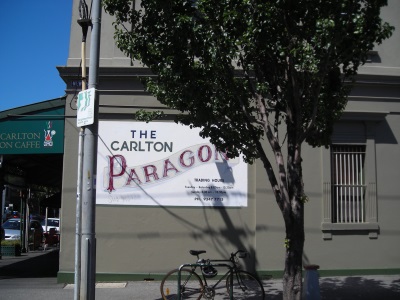
Photo: CCHG
Paragon Café Signage
Corner of Rathdowne and Newry Streets, North Carlton
|
Gone ... Gone ... Paragon
After three decades in Rathdowne Street, North Carlton, the Paragon Café has served its last coffee.
The Paragon was not the first café to occupy the Rathdowne and Newry Streets corner site and, if history repeats itself, will not be the last.
The two-storey building at 651 Rathdowne Street dates back to 1892 and has served various business uses as a drapery, light manufacturer, milk bar and confectioner.
The café (or caffe) connection began in the 1960s, when black and white stripes appeared on the side wall to represent the Italian soccer team Juventus.
The Italian caffe of the 1960s became Tony's Espresso Bar from 1974, and the Paragon from November 1986. 1,2
The Paragon's recent history has been newsworthy, with two significant events in 2014 and 2015.
In June 2014, a stolen car driven by a drug-fuelled man mounted the footpath, travelled for a block along Rathdowne Street and crashed into the front of the Paragon.
Miraculously, no one was seriously injured, but several businesses suffered damage to stock and buildings.
The driver, who had mental health issues and prior convictions, was later sentenced to four years' jail.
Less than a year later, in May 2015, a fire broke out in the basement and the building suffered smoke and water damage.
The Paragon re-opened for business after repairs, but has since been closed for extensive renovations as an Italian restaurant, opened in September 2016. 3,4
With the closure of the Paragon Café, the side wall has been painted over and North Carlton has lost the distinctive signage that once graced Newry Street.
Notes and References:
1 Walking along Rathdowne Street : 100 years of shopping, services and stories in North Carlton. CCHG, 2012. p. 60.
2 The Age, 10 February 1987, p. 32
3 The Age, 28 June, 2014
4 The Age, 11 May, 2015
|
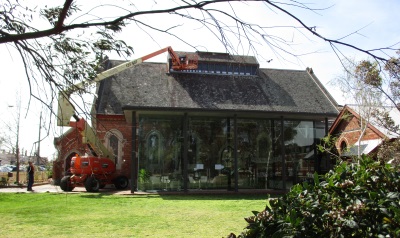
Photo: CCHG
St Michael's Church
Corner of McIlwraith and Macpherson Streets,
Princes Hill
|
Scaling the Heights at St Michael's Church
Prayer might bring you closer to God, but sometimes a little extra help is needed.
This crane was deployed to enable safe access to the roof of St Michael's Anglican Church for maintenance work to be carried out.
The situation would have been very different in 1885, when the church was built.
Before the advent of safe work practices in the construction industry, workers would have been climbing up rickety wooden scaffolding and hauling loads of bricks by hand.
The foundation stone for the church was laid by Sir George Verdon on 18 February 1885 and the opening service was held on Sunday 24 May in the same year.
The brick church was designed by architect James Gall (Gaul) and built by Robertson and Stewart.1,2
Prior to 1885, there was no Anglican church in North Carlton and Princes Hill to serve the pastoral needs of the growing population.
The nearest churches were St Jude's in Lygon Street, Carlton, and St Luke's in St George's Road, North Fitzroy.
In 1885, Bishop Moorhouse sanctioned the separation of North Carlton to form a separate parish and St Michael's was born.
A suitable site was found on the corner of Tucker (now McIlwraith) and Macpherson Streets and the land was procured by James Moorhouse, William Edward Hearn and Thomas Turner a'Beckett on behalf of the Anglican Church.
The new parish and the building of the church had the full support of the community.
Architect James Gall drew up the plans free of charge and the project was funded by donations and interest-free loans.
Parishioners provided material support with donations of carpeting, chairs and other furniture, a church bell, collecting plates and communion cloths.3,4
References:
1 North Melbourne Advertiser, 20 February 1885, p. 3
2 North Melbourne Advertiser, 29 May 1885, p. 3
3 Certificate of Title, Vol. 1654, Folio 686, 1885
4 The St. Michael's Story : 125 years of Anglican Ministry in North Carlton.
St. Michael's Anglican Church, 2010
|
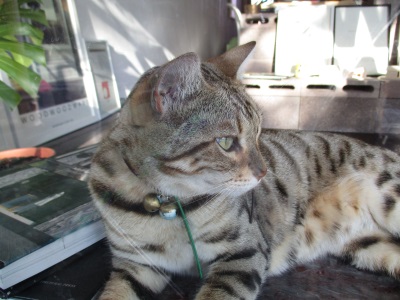
Photo: CCHG
Boo @ Wowowa
420 Rathdowne Street, North Carlton
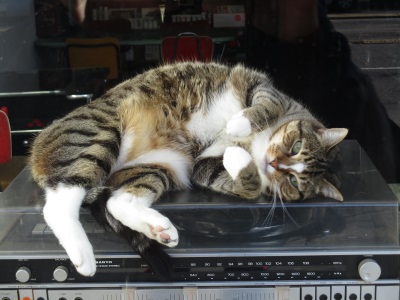
Photo: CCHG
Betty Boo @ Babar
635 Nicholson Street, North Carlton
|
The Cat in the Window
Rathdowne Street has a long tradition of shop cats, the most famous being "Pam Puss".
Pam, a friendly tabby, was the resident cat at The Picture Box (now a café) at 412 Rathdowne Street, North Carlton, until her death in the mid-1990s.
When the "black comedy" book 101 Uses for a Dead Cat was published, Pam featured in a window display and the sight of a real cat curled up asleep amongst the books no doubt boosted sales.
Her photograph appeared in the magazine New Idea, though unfortunately they got her name wrong - such is the price of celebrity.1
In 2016, Rathdowne Street has a new shop cat named "Boo" at no. 420, just a few doors north of Pam's old home.
Boo is often seen basking in the afternoon sun in the display window of Wowowa, an architecture and interiors business.
From his vantage point, Boo keeps an eye on the passing pedestrian traffic, both human and animal.
He sometimes visits the optometrist Eyes on Rathdowne next door (no. 422) to check out his feline neighbours, "Pusslldo" and "Littlepuss", two lovely Tonkinese cats.
Boo has a female namesake, Betty Boo, who graces the window of Babar Hair at no. 635 Nicholson Street, North Carlton.
Betty, a tabby cat, is technology savvy and has her own facebook page.
Like Boo, Betty enjoys sunning herself in the shop window and her favourite spot is on top of the record player.
Have Boo and Betty Boo ever met?
Unlikely, as they live several blocks away from each other, but you never know.
Postscript:
Boo went missing in May 2017 and he no longer graces the window of 420 Rathdowne Street.
Littlepuss died in April 2019.
Note:
1 101 uses for a dead cat, by Simon Bond, was first published in 1981.
|
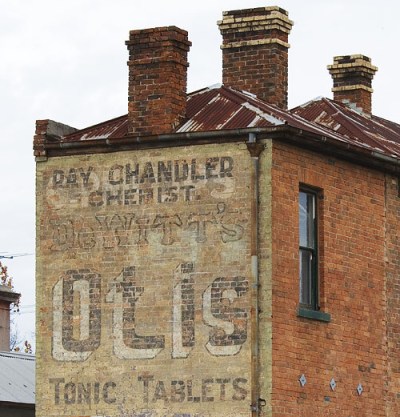
Photo: Courtesy Fading Victoria
Rear of 536 Rathdowne Street, North Carlton
|
The Case of the Missing Tonic Tablets
When Ray Chandler, namesake of the popular American detective writer,
took over the chemist shop on the corner of Rathdowne and Richardson Streets North Carlton in 1926,
the writing was already "on the wall", so to speak, for Otis tonic tablets.
The tonic tablets, manufactured by E.C. De Witt & Company, were advertised as a "guaranteed remedy for debility, brain fog, anaemia, depression, morbidness, maternity weakness, neurasthenia, insomnia, premature decay
and all ailments arising from blood poverty or depleted nervous energy."
De Witt was so confident of the product that it offered a full refund if the tablets "fail to do all that is claimed of them". 1
Advertisements for Otis tonic tablets appeared in newspapers from 1922 to 1925 - a relatively short life -
while other De Witt's products continued well into the 20th century and beyond.
Were Otis tonic tablets a victim of their own money back guarantee or did they disappear from the market for some other reason?
Unlike the short-lived Otis tonic tablets, 536 Rathdowne Street has a long history of continuous service as a chemist shop from 1913 to 1987.
The first chemist, O. Smith, opened for business in 1913 and was replaced by C. Phillips from 1921 to 1925.
The wording "C. Phillips" can still be seen under Ray Chandler's name.
Chandler served the local community until 1947, continued by I.L. Atkins from 1948 to 1967, and S. Benporath from 1968 to 1978.
David Nolte was the final chemist shop occupant from 1979 to 1987, when he moved to new premises at 701 Rathdowne Street.
David Nolte's pharmacy bears the date "Est. 1913" in acknowledgement of Smith's original chemist business. 2
References:
1 Advertisement in The West Australian, 19 July 1923, p. 5
2 Building occupancy information sourced from Sands & McDougall
|
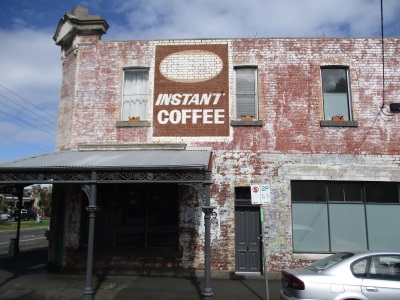
Photo: CCHG
Instant Coffee Signage
Corner of Canning and Pigdon Streets, North Carlton
|
Coffee in an Instant
You won't find instant coffee on the menu at Monforte Viennoiserie, at the rear of 585 Canning Street, North Carlton.
The prominent signage on the brickwork facing Pigdon Street harks back to an earlier time, when the convenience of instant coffee was valued over the flavour of a freshly brewed cup.
Until 1889, the corner site was vacant land owned by Thomas Allison.
In July of that year, Mr Allison lodged a notice of intent to build "six 2-storey houses" on the corner of Canning and Pigdon streets.
The buildings were designed by James Clarke and built by Donald McDonald.
Construction work was still in progress in 1890, when the rate books listed three houses and a shop as "erecting" in Canning Street (nos. 579 to 585),
and two houses around the corner in Pigdon Street (then nos. 87 and 89, now nos. 75 and 77).
The shop began its life as a greengrocer in 1891, followed by an extended period as a grocer and confectioner.
In the second half of the 20th century, it was a milk bar, and the signage is still visible at the front door.
Remnants of Bushells tea signage can be seen near the serving window in Pigdon Street and, on the upstairs rear wall,
you can just make out the wording "Lanchoo", a rival of Bushells in the tea stakes.
Notes:
Building ownership and occupancy information has been sourced from land title records, Sands & McDougall directories, Australian Architectural Index and Melbourne City Council rate books.
|
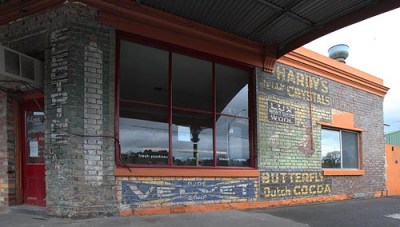
Photo: Rowan Crowe
187 Fenwick Street, North Carlton
|
The Best Candles in the World
Renovations to Filou's Patisserie, on the corner of Fenwick and Lygon Streets North Carlton, have uncovered advertising images from an earlier age as a grocery shop.
Products like Lux Flakes and Velvet Soap may be familiar, but what about Hardy's Jelly Crystals, Butterfly Dutch Cocoa and Electrine Candles, claimed by manufacturer Kitchen and Sons to be "the best candles in the world."1,2
The full length candle image on the left hand side recalls a once-essential household product.
As reported in The Camperdown Chronicle in 1926, "One would have thought that with the ever-increasing use of gas and electricity that the market for candles would have become a negligible quantity, but that there is still a big demand for these handy little articles of illumination".3
References:
1 Hardy's Jelly Crystals and Butterfly Dutch Cocoa were products of local merchant R.J. Hardy and Co., of Macpherson Street, North Carlton.
2 Advertisement in The Argus, 18 September 1883, p. 3
3 The Camperdown Chronicle, 14 December 1926, p. 3
|
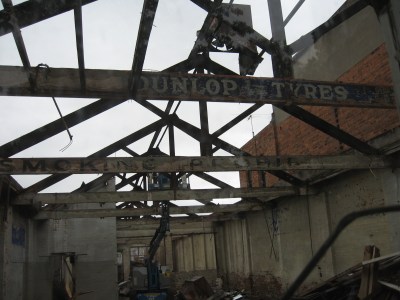
Photo: CCHG
"Dunlop Tyres" and "Smoking Prohibited" signage
520-522 Rathdowne Street, North Carlton
|
A Sign of the Times
Demolition and redevelopment are a part of life in inner city suburbs and sometimes little gems of history are uncovered in the process.
Mode Drycleaners at 520-522 Rathdowne Street North Carlton closed in March 2011 and, after two years of vacancy, the site was demolished in late 2013 to make way for redevelopment as apartments.
The advertising signage "Dunlop Tyres" on the roof beams recalls the building's first use as a motor garage in the 1920s, while "Smoking Prohibited" could equally apply to the drycleaning business of the 1940s.
In 1921 Martin Shelley built a motor garage and service station on the previously vacant land.
At first the building covered only the front half of the site with a yard at the rear, where two underground petrol tanks were installed.
But this area was soon, probably before the end of the 1920s, included in an extended building which took up the whole site.
Two decades after it was built, the building became a dry cleaner's.
A shallow shop front with a simple deco pediment replaced what would have been a wide entrance, similar to that from the side lane off Richardson Street.
The use and appearance of 520-522 Rathdowne Street then remained unchanged for seventy years.
More information
|
Digitised image courtesy of Connections Uniting Care
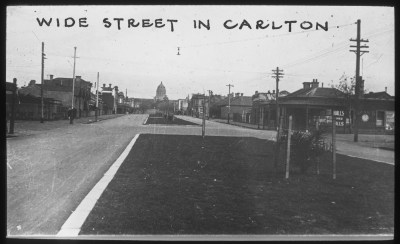
Canning Street, Carlton, in the 1930s
|
Where Palm Trees Once Grew
This street scene, photographed by housing reform campaigner Oswald Barnett in the 1930s, is easily recognised as Canning Street, Carlton,
facing south towards the Exhibition Building.
The grassed plantation was established in 1927. The young palm trees originally ran the full length of Canning Street, but now survive only north of Curtain Street.
1
The cross street is not named, but careful observation identifies it as Kay Street.
The main clue is a series of rooflines on the left hand side of the photo, corresponding to four single storey houses that still exist today.
Sands & MacDougall confirms that the south east corner was occupied by Geo. Berry's woodyard, and the south west corner by Shoebridge's grocer shop in the 1930s.
The buildings on both these corners have been replaced by more recent structures.
1 The Argus, 25 November, 1927, p. 13
|