Carlton Community History Group
News Archive
2025
Remembering Paula Huston
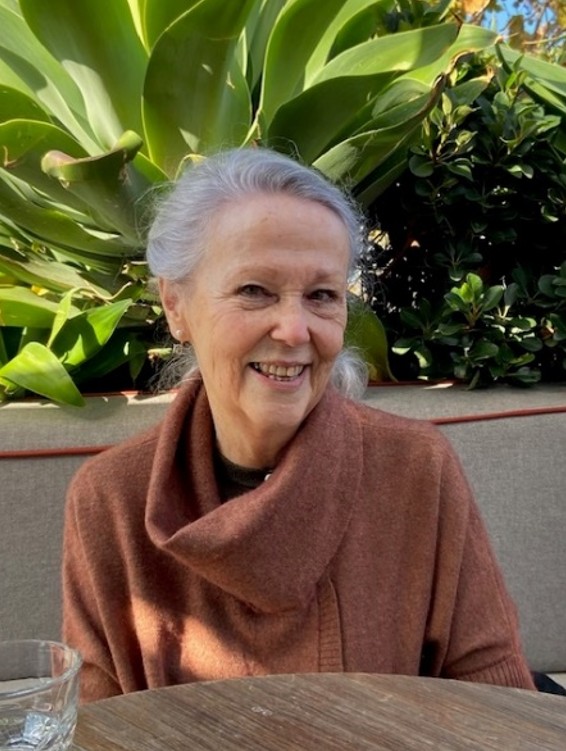
Paula Huston
28 April 1949 – 14 November 2025
The Carlton Community History Group (CCHG) was saddened to learn of the recent death of Paula Huston. A vivacious and charming woman, Paula was a volunteer on the Carlton Community History Group's guiding Committee until she became seriously ill in May 2025. She brought to her volunteer work an intense interest in the history and heritage of Carlton, North Carlton, Princes Hill and Parkville. Her home city was Perth, Western Australia, and our local history was new to her. As a former teacher of History and English, she did a great job proofreading articles for the CCHG website. As a former well-travelled RAAF wife, she brought fresh ideas to our meetings. She was a remarkable woman and will be greatly missed.
From the Aeolian Islands to Lygon Street
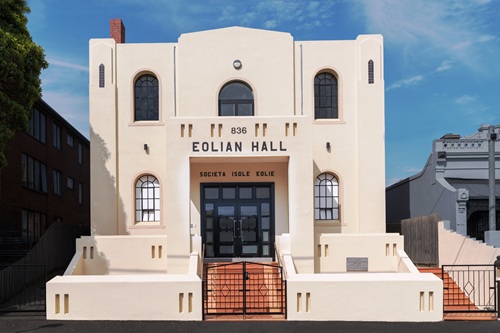
Courtesy of Società Isole Eolie
Eolian Hall, 836 Lygon Street, North Carlton
The Società Isole Eolie, Melbourne's longest-running Italian social club, celebrates its 100th anniversary in 2025. The Società Mutuo Soccorso Isole Eolie, as it was originally known, was established in 1925 by a group of migrants from the volcanic Aeolian islands, off the coast of Italy. The wording "Mutuo Soccorso", translated as "Mutual Aid", reflects the founding charter to be a social, cultural and welfare point of reference, aiming to help Aeolian migrants settle in Melbourne, offering them a place to meet, as well as providing moral and financial assistance in times of need. The Società is a not for profit organisation, funded by member contributions.
In the early years, the Società met at various locations, and in November 1968 acquired its present home at 836 Lygon Street, North Carlton. The impressive building was originally a Jewish Kadimah, designed by Architect C. J. White and constructed by F.N. Mann Pty Ltd in 1932, and officially opened in March 1933. The former Jewish National Library and Celia Grosby Memorial Hall was renamed Eolian Hall and has undergone extensive alterations over the decades. The 100th anniversary is being celebrated in a series of events in 2025.
More information: https://eoliemelbourne.com.au/100years/
From Spaghetti to String Bikinis
677-679 Nicholson Street North Carlton
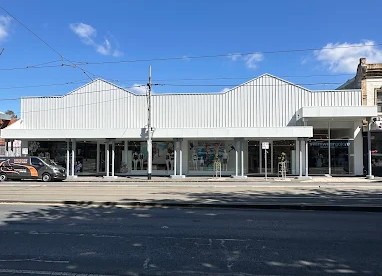
Photo: Courtesy of Swimwear Galore
Spring is here and summer is just around the corner. If you're looking to buy a new swimsuit, a North Carlton business may have the answer. After five years of vacancy, the former Maria's Pasta factory and shopfront in Nicholson Street, North Carlton, has had a makeover as the new retail premises for Swimwear Galore, formerly of Brunswick Street, Fitzroy. The wide shopfront opened in October 2025 and offers a very different range of products, compared to Maria's Pasta.
The large brick building at 677-679 Nicholson Street has had several incarnations during its 139 year history. It was originally built by James Spicer, staircase maker, as a joinery factory in 1886. James Spicer died in 1893 and the factory building was bought by William Angliss, a local butcher who went on to build a business empire in the meat and pastoral trades. Under his ownership, the factory became a printing works and, in 1898, it was home to Madame Demaret & Company, publisher of dressmaking patterns and the "Glass of Fashion" journal. Madame Demaret's patterns were widely sold, with agents appointed in Victoria and interstate.
From 1906 to the early 1930s, brewing was the business of the day. The Stacey Brewing Company was well known for its non-alcoholic beer, favoured by temperance advocates, while Bux Brewing had its signature "Stockade" brand, made from Tasmanian hops. Then there was a succession of motor tyre businesses from the mid 1930s through to the 1970s – Thompson & Son Motor Tyres, the Indo Rubber & Tyre Company, and Firestone Australia Pty Ltd. The original 1880s brick structure was substantially rebuilt in 1944, following a fire that sent clouds of acrid smoke from burning tyres over the city and surrounding suburbs. A new roof and verandah were added in later years, between the most recent businesses – A distribution centre for Sigma Pharmaceuticals and, from 1995 to 2000, Maria's Pasta. 1,2,3
References:
1 Business occupancy information sourced from Sands & McDougall directories and newspaper advertisements,
with additional information from Maria's Pasta.
2 The Argus, 8 April 1944, p. 4
3 Melbourne Building Application Index
Stories of Service and Sacrifice
Carlton During World War 2
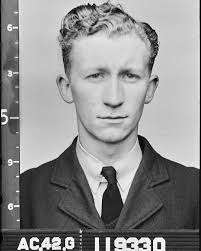
Image: NAA: A9301, 119330
Joseph Anthony Battanta of Princes Hill
Patrick Ferry from National Archives of Australia gave an outstanding presentation at the Kathleen Syme Library & Community Centre, 251 Faraday Street, Carlton, on 24 May 2025. Patrick is the Project Manager for the Digitising Services Team (Defence Services Records) of the National Archives. The topic was stories of service and sacrifice by volunteers from the Carlton area during World War Two. The case studies brought history to life as well as illustrating the methodology of the National Archives. Military historians were among those who attended. This presentation was part of an ongoing Carlton Community History Group collaboration with the Kathleen Syme Library & Community Centre. The venue offers meeting rooms available for booking and a café nearby.
The public can access digitised service records online at www.naa.gov.au or by ordering original records held in Melbourne for viewing at the Victorian Archives Centre, 99 Shiel Street, North Melbourne. The reading room is co-located with the Public Record Office of Victoria and open from Wednesday to Friday from 10.00 am to 4.30 pm.
2024
Seventy Years of Weaving and Spinning
The Handweavers and Spinners Guild of Victoria celebrated its 70th anniversary in 2024 and has a long association with Carlton and North Carlton. The Guild was originally established as the Victorian branch of the New South Wales Guild in 1952. As interest and membership grew, the Guild became a not-for-profit organisation in its own right. The first meeting was held at the Public Library (now State Library of Victoria) in April 1954. For the next nine years, the Guild met at several city locations and in 1963 moved to the Loyal Orange Lodge at 524 Elizabeth Street, Carlton. There was another move in 1971 to the Horticultural Hall (popularly known as "Horti Hall") in Victoria Street, opposite Trades Hall. In the 1980s, the Guild became part of the wider craft movement at the Meat Market Craft Centre (MMCC) in North Melbourne. This was not to last, as the MMCC closed suddenly in 1999.1
In 2000, the Guild had to find new premises and the site chosen was in North Carlton. The scout hall at 12 to 18 Shakespeare Street dates back to the 1930s. The foundation stone was laid by the Lord Mayor Councillor Luxton in July 1930. The hall was purpose-built for public performances, with a raised platform, off-stage dressing rooms and cloakrooms. It served a dual purpose in providing a home base for the First Carlton Troop and also a source of income from hiring out the premises for public and private functions. When the Guild moved in, the building was a bit run down and had problems with water damage, but it provided a large open space for classes and workshops and a single storey setting. No need to carry bulky weaving looms and spinning wheels up and down the stairs.2
By 2011, the building was long overdue for renovation, and also required for scouting activities. Once again, the Guild had to find another home. This was a two-storey building at 655 to 657 Nicholson Street, North Carlton, a 1970s structure with a retail shopfront on the ground floor and a gym above. While not a heritage building, the new location offered more exposure in a local business and shopping precinct, with ready access to public transport. The Guild is expanding its floor space in 2025 by leasing the ground floor of the adjacent building at 653 Nicholson Street. This will provide improved access and facilities for classes and workshops. The two storey shop and its neighbour at 651 were built for Louisa Jones in 1888. The first occupants were the Harmsworth Brothers, painters & decorators, followed by a succession of businesses – confectioner, greengrocer, jeweller, cycle depot, optician, pawnbroker, chemist, real estate agent and restaurants offering a variety of cuisines. The most recent businesses have been the Koca Lane salon and Moosa Bar.3
Adding up the years, the Handweavers and Spinners Guild of Victoria has spent nearly half of its lifetime in Carlton and North Carlton, and has woven its way into our history.
1 Paramanathan, Elizabeth. Arachne's Children, 2006
2 The Argus, 21 July 1930, p. 7
3 Building ownership and occupancy information sourced from land title records, the Victorian Heritage Database, Sands & McDougall directories and newspaper advertisements.
More on Shakespeare Street
Last Tram Out of the Depot
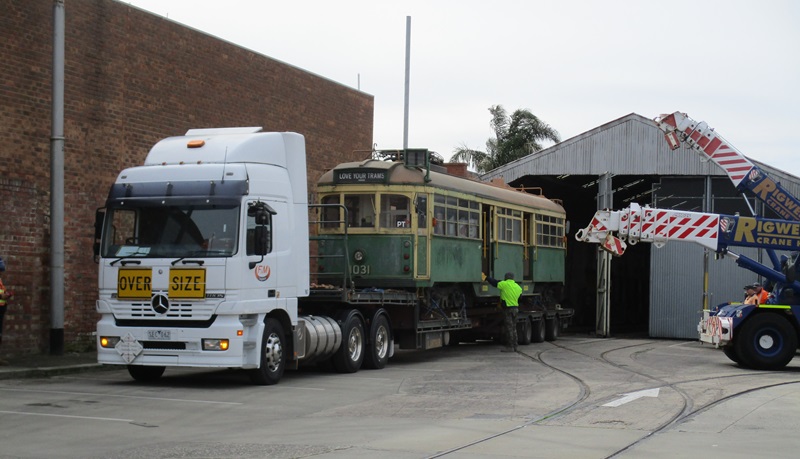
Photo: CCHG
W7 class tram no. 1031 in prepartion for its final run out of the former tram depot in Nicholson Street.
The cranes on the right hand side were used to lift the tram onto the back of an over size load truck.
Friday 23 August 2024 marked the end of an era for W class trams in Nicholson Street, North Carlton and North Fitzroy. W7 class tram no. 1031 was the last of six W and SW class trams to be removed from the former North Fitzroy tram depot, where they had been in storage since 2014. The depot, now home to the bus company Kinetic, serviced the Nicholson Street tram route from 1956, when electric-powered trams replaced buses on the Bourke Street to East Brunswick run. 1956 was also the first year that tram no. 1031 came into service. However, the history of trams in Nicholson Street goes back as far as 1887.1
The Nicholson Street cable tram service opened in 1887 and was the first to operate in Carlton. The introduction of affordable public transport was a boon to residents and businesses on both sides of Nicholson Street, and facilitated development of the shopping precinct as far as Park Street, North Carlton. The cable trams served their purpose for decades, but they were considered an inefficient mode of transport into the 20th century. The Nicholson Street cable trams were replaced by buses in October 1940. London-style double deck buses operated for a time, but they proved inefficient at peak hour and were phased out. The service was restored with electric-powered trams in April 1956 and, with major upgrades in infrastructure and rolling stock, continues to this very day. The tram tracks leading into the depot are still visible, but a short section connecting to the main line in Nicholson Street was removed in January 2020, when the tram tracks were dug up and re-instated during installation of new accessible tram stops.2
View video clip of W7 class tram 1031 leaving the North Fitzroy depot on Friday 23 August 2024.
Notes and References:
1 https://vicsig.net/index.php?page=trams§ion=heritage&museum=north%20fitzroy
2 Jones, Russell. No stairway to heaven : the failure of double deck buses in Melbourne. Melbourne Tram Museum, 2017
Walking with Curiosity and Eyes Open
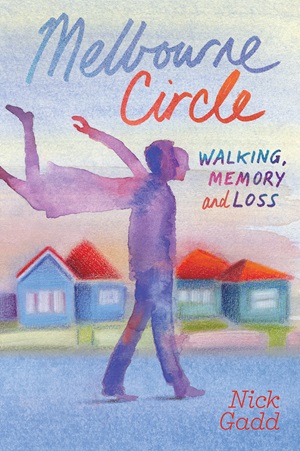
Image: Courtesy of Nick Gadd
Despite the threatening wind and rain, some 45 people attended a fascinating presentation by Nick Gadd on the afternoon of Saturday October 5th at the Kathleen Syme Centre in Faraday Street, Carlton. Nick shared his experience of circumnavigating the whole city of Melbourne with his late wife Lynne in a rough circle in a series of casual walks. Walking with curiosity and open eyes, they discovered much to share.
In this presentation, for lovers of history Nick focused on ghost signage with excellent photos of signage for past businesses and of advertising for products that no longer exist. A nineteenth century advertisement for medical services led them to another advertisement for the doctor which mentioned that he could use his clairvoyant skills to diagnose what was wrong with patients if they were unable to attend in person. Nick introduced us to 'lost things' such as a building in Chapel Street, Prahran, with a very elegant but neglected facade that could have been a glamorous arcade to rival the Royal Arcade. The completion of the building unfortunately coincided with the economic depression of the 1890s and its owners dream was never realised. Following a grand opening with thirty shops, plus businesses that included a Turkish bathhouse, billiard rooms, a restaurant, an oyster saloon and the splendid Arcade Club Hotel, the owner had to sell.
A lively question time ran for 15 minutes. Nick's book 'Melbourne Circle' is still available in bookshops. That is fortunate as the dozen or so copies that Nick had brought along were too few for the attendees who were keen to buy a copy. The talk was organised by the Carlton Community History Group in partnership with the Kathleen Syme Library and Community Centre.
"The Doll" in Carlton
Ray Lawler, acclaimed playwright, actor, director and producer, died on 24 July 2024, aged 103 years. Lawler's best known work was his stage play "Summer of the Seventeenth Doll", first performed by the Union Theatre Repertory Company at the Union Theatre, Melbourne University, on 28 November 1955. The play was set in a boarding house in Carlton in 1953, where itinerant cane-cutters Roo and Barney travelled south from Queensland each year during the summer lay off season and renewed their relationships with barmaids Olive and Pearl. The "doll" of the title refers to a decorated kewpie doll on a stick, a popular carnival novelty in the 1950s. The play was remarkable in realistically portraying the lives of working class Australians. Ray Lawler, an actor in his own right, performed in the role of Barney in the original production, directed by John Sumner. According to fellow playwright Gordon Kirby, a long term Carlton resident, Ray Lawler lived in Carlton for six months only, but the inner city suburb must have made a lasting impression on him.1,2
"Summer of the Seventeenth Doll" went on to be performed, to critical acclaim, in England in 1957, followed by a season in the United States in 1958. American audiences did not quite "get" the nuances of Australian language and culture. However, in 1959 "The Doll" was given the full Hollywood treatment with a film adaptation, directed by Leslie Norman. The screenplay was written by John Dighton and the cast featured American and British actors Ernest Borgnine, John Mills, Anne Baxter and Angela Lansbury in the leading roles. Mills took the part of Barney, originally performed on stage by Ray Lawler, and several Australian actors had supporting roles. The film was shot in Australia, but the location was moved to Sydney, with views of the harbour bridge to remind filmgoers where the action was taking place. The ending was also changed, to give it a more positive spin. The film received mixed reviews in Australia, with one reviewer summing up: "In a word … DISAPPOINTS."3
Ray Lawler lived and worked overseas for the next decade, returning to Australia in the 1970s. He wrote two prequel plays to "The Doll" – "Kid Stakes" set in 1937 and "Other Times" in 1945 – thus completing "The Doll" trilogy. The new plays were first performed by the Melbourne Theatre Company in December of 1975 and 1976 respectively. In 1978, "The Doll" trilogy returned to its original roots, with all three plays performed and filmed at the Open Stage in Carlton. This was not a feature film or television adaptation, but an authentic portrayal of the stage plays, as performed by the Melbourne Theatre Company. The plays, comprising seven and a half hours' performance time, were screened on the Channel Seven television network.4
Nearly seventy years after its premiere performance in 1955, the play has been staged extensively in Australia and overseas. "The Doll" has stood the test of time and remains a fitting tribute to Ray Lawler's body of work.
Notes and references:
1 Lawler, Ray. The Doll Trilogy : Kid Stakes, Other Times, Summer of the Seventeenth Doll. Currency Press, revised edition, 2015
2 The Australian Women's Weekly, 22 October 1958, p. 12
3 The Australian Women's Weekly, 16 December 1959, p. 66
4 The Australian Women's Weekly, 22 February 1978, p. 31
Full House at Enoteca Sileno
John Portelli
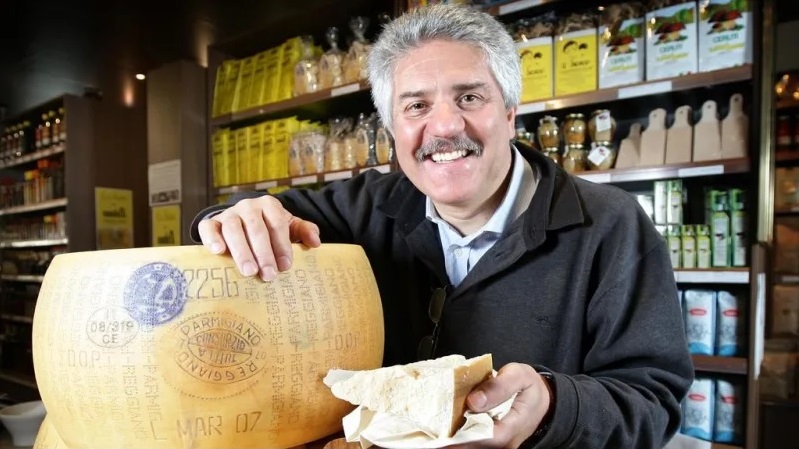
Carlton Community History Group has returned to in-person history talks in addition to its popular Zoom presentations. The first history talk for 2024, held at Enoteca Sileno on Saturday 13 April, was booked out in a few days. The topic was "Changing Melbourne's Food Habits: 50 Years of Promoting Italian Food and Wine in Carlton". The speaker, John Portelli, is a major contributor to the Carlton food and wine scene. Some members will remember John's appearance in the cinema documentary film "Lygon Street: Si parla Italiano" which documented the emergence of Lygon Street as the birthplace of Melbourne's world famous café culture and of the adoption of Italian cuisine. John started working part-time at the Lygon Food Store in 1970 as a teenager. He remembers cutting 35 kilogram wheels of parmigiana with an almond knife, six days a week. He told stories first of the days when the customers were Italian post-World War 2 migrants. They expected value for money, down to how much rind was on a piece of cheese, and sought out authentic produce from their own home regions of Italy.
Lygon Street proprietors used various methods to attract people from non-Italian backgrounds. Traders initiated an annual Italian Lygon Street festival in 1978, with many exhibitions and performers travelling from Italy to take part. These included the extremely popular "Sbandieratori" (flag-wavers from Gubbio) who, for many years, delighted the crowds with colourful displays of traditional medieval flag-throwing. Much-loved local events included "L'Albero della Cuccagna" (Greasy Pole Climbing), the Waiters' Race and "Spacca Pignatte" (Break the Pots). John had us laughing as he described his job of applying automotive bearing grease on the pole before the competition began. Regional Italian foods and music were a greatly anticipated part of any Festa. Giveaways of freshly baked Italian panini with olive oil at the Festa proved very popular
John became a regular guest speaker with Martha Gardner from radio station 3AW. The Tiramisu dessert made with newly available mascarpone cheese was first launched from the 3AW Broadcast Caravan outside the Royal Exhibition Building at the Home Show in the late 1970s. Demand for the recipe, and sales of the mascarpone to restaurants and consumers, was extraordinary. Plasmon, Italy's most famous brand of infant foods was imported and sold to European and Australian mothers for 55 years and was one of the first brands imported by migrant businessman Gino Di Santo who came to Australia in the 1950s. Gino Di Santo launched the first real Enoteca in Australia, Enoteca Sileno, inaugurated in 1982 with 180 Italian regional wines. Enoteca Sileno also pioneered the importation and sales of other significant products into Australia, such as extra virgin olive oils (over forty years ago), real balsamic vinegar, the condiment vinocotta, plus genuine artisan made pastas, authentic Vialone & Carnaroli risotto rices, the highest quality Xmas Panettoni cakes, and hundreds of other brands & products.
These days John promotes Italian artisan foods and wines as co-Director, with his wife Rosemary, of Enoteca Sileno in North Carlton, which is a major wholesale provider of Italian wines and produce. The family also have a retail show room on site. John's passion for quality, traditional methods and regional variety is just as strong as ever.
Related Item: Enoteca Sileno Gastronomia dal 1953
Little but Fierce
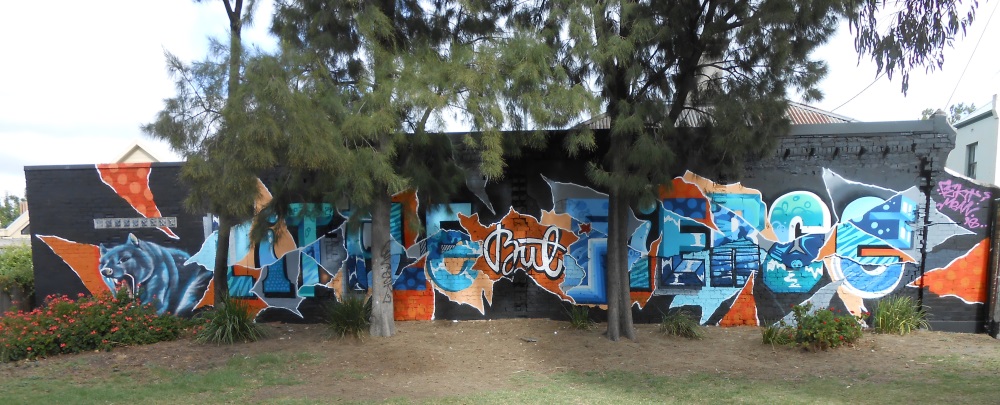
Photo: CCHG
Shakespeare Street Mural
North Carlton
The colorful mural that once faced the mini park in Shakespeare Street, North Carlton, was painted over in 2024. All that remains of this brief snapshot of Shakespeare Street's history is a small patch of orange paintwork in the far corner. The text "Little but Fierce" is taken from William Shakespeare's play A Midsummer Night's Dream and was suggested by a local resident. The full wording is: "And though she be but little, she is fierce". That Shakespeare Street is "little" there is no doubt. The street is narrow and runs for one block only, between Drummond and Lygon Streets. For the "fierce" side of Shakespeare Street, we need to look back in history.
Shakespeare Street was the scene of at least two shooting incidents, one fatal, in 1922 and 1944. The street was identified as a "slum pocket" by the Housing Investigation and Slum Abolition Board in 1936-37. The people of Shakespeare Street had a battle on their hands in the 1950s and 1960s, when the Housing Commission of Victoria condemned five cottages on the south side (nos. 7 to 15 inclusive) as unfit for human habitation. The cottages were demolished in January 1970, leaving a vacant space ready for development. Without doubt, the fiercest battle fought in Shakespeare Street was in the 1970s, against the inappropriate building of a block of cluster flats on the south side of the street. Residents and other concerned citizens took action, at their own expense, by cleaning up the vacant site and creating a mini park for the benefit and enjoyment of the community. They bravely put their money where their mouth was, so to speak, and entered into an agreement with the City of Melbourne to buy the land. Decades later, the mini park remains a tribute to the power of community action.
More information on Shakespeare Street
Related items:
Shooting in Shakespeare Street
The Penny Dreadful
2023
Vale Judith Biddington
1933-2023
CCHG
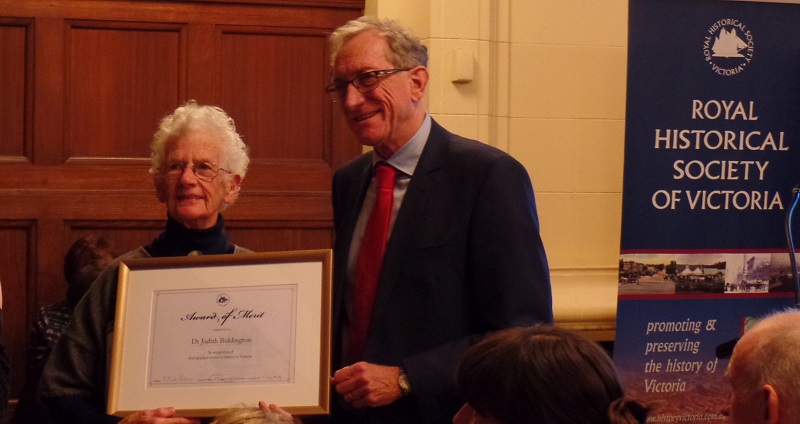
Judith Biddington (left) receiving her Award of Merit from Richard Broome in 2019
Dr Judith Biddington, founding President of the Carlton Community History Group (CCHG), passed away on 13 December 2023. She will be sadly missed by CCHG and the broader community. Judith and her husband Ralph, who died in 2019, lived in Drummond Street, North Carlton, since the 1970s. She was a teacher and education academic by profession, and had a passionate interest in history. In this capacity, she identified the need for a local community history group covering Carlton, North Carlton and Princes Hill. In 2006, Judith placed a notice at the Carlton Library in Rathdowne Street and, together with several like-minded people, held a series of meetings with presentations from people on living, growing up or working in Carlton. Within a year the Carlton Community History Group became incorporated and had achieved affiliation with the Royal Historical Society of Victoria. From the start Judith's approach was to engage with local people directly – shopkeepers, teachers, potential speakers for meetings, long term residents, representatives of religious organisations like churches and the local mosque – gathering history on the ground and, most importantly, involving and engaging people.
Along with several other hard working and dedicated members, Judith began recording a series of interviews with present and former Carlton residents. These oral histories have now been digitised and made more accessible. She also began a series of special events and regular publications produced by CCHG, commencing with her own booklet "Some Women of Davis Street : 1891 and 2008". Judith edited Des Norman's book "Through the eyes of a child : A street in Carlton 1939-45" and contributed a chapter to CCHG's publication "Carlton Voices", launched in October 2018. In addition to her presidential responsibilities, Judith was not above taking on mundane tasks to get the job done. She was known to hand-deliver minutes of meetings to members who lived locally, and her full commitment to CCHG was both a strength and weakness. Judith was also active in the "Friends of the Carlton Library". As the workload increased, Judith stepped aside as President in 2012, but she maintained a lifelong interest in CCHG. She was presented with an Award of Merit by the Royal Historical Society of Victoria for "meritorious service to a historical society" in May 2019.
I first made contact with Judith in 2007, not long after CCHG became incorporated. Finding no information online, I used the old-fashioned method of looking up the telephone book and found a listing for "Biddington" in Drummond Street. This proved to be correct and Judith, who answered my call, seemed a little surprised that someone would be contacting her out of the blue. When I mentioned the lack of a web presence and offered to create a basic website, she seemed even more surprised. Sixteen years later, the CCHG website is still basic, but has grown in scope and content. Judith was a regular contributor, writing articles and book reviews. She had a good writer's knack of selecting text from various sources and turning it into a story. Judith was a stickler for keeping printed copies of documents, not fully trusting the longevity of the electronic versions. Like many seniors, she just wanted her computer to work without having to upgrade the software or hardware all the time.
Judith Lorraine Biddington (née Russell) was the granddaughter of Delia Constance Russell, a well known community worker and social activist. Delia died in 1938, when Judith was a young child, but she would have been proud of her granddaughter's achievements. CCHG has grown through Judith's vision and leadership, for which we give our heartfelt thanks. Our condolences to her sons David, Peter and Jon.
Susan C. Crowe
Website Administrator
Carlton Community History Group
December 2023
Pillar Box Man
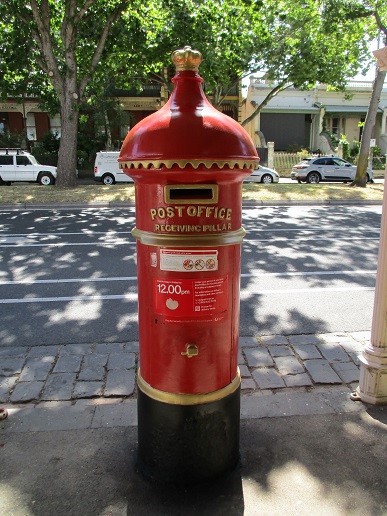
Image: CCHG
Restored Pillar Box outside 428 Rathdowne Street North Carlton
Note that part of the "fist" door handle is missing on the right hand side
An historic pillar box in Rathdowne Street, North Carlton, had a makeover in November 2023, with its paintwork restored to original colours of red and gold on a black base. The restoration work was done by a pillar box enthusiast, Mick Slocum, who initially began his work on a voluntary basis and is now supported by Australia Post. The pillar box is located directly outside 428 Rathdowne Street and this building has historic connections with early postal services in the area. Prior to the opening of the new purpose-built North Carlton Post Office at 546 Rathdowne Street, postal services were provided at several different locations in North Carlton. The first North Carlton Post Office premises recorded in Sands & McDougall in 1888 was a shop at 783 Rathdowne Street, near the Macpherson Street corner. Miss Eliza White was the postmistress and she shared the premises with Mrs G. White, a stationer. Miss and Mrs White remained at the address until 1892, when both moved to 797 Rathdowne Street, a short distance north of the Macpherson Street corner. The next move occurred in 1896 to 428 Rathdowne Street, on the east side, and the last recorded listing at this address was in 1913. The North Carlton Post Office, on the corner of Richardson Street, was closed in October 2022 and relocated to 607 Lygon Street, Princes Hill.
Related Item: The Last Post for Rathdowne Street
Bye Bye Babajan
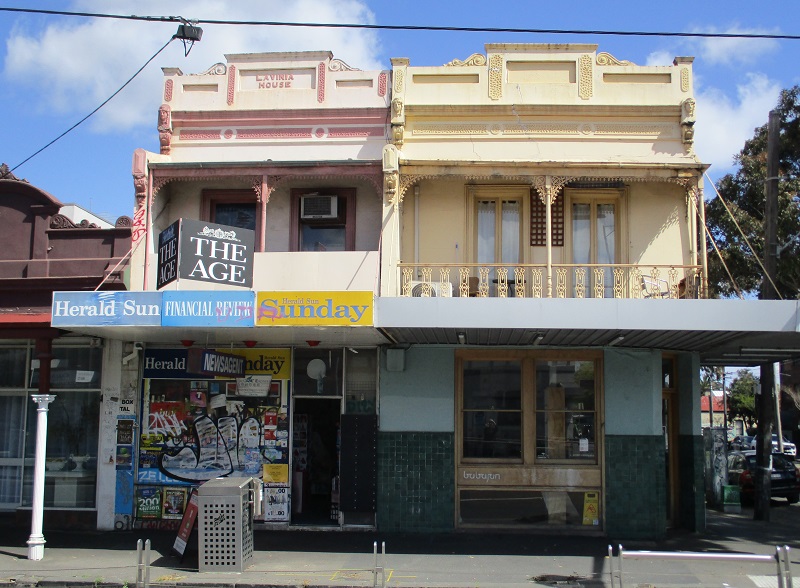
Image: CCHG
Lavinia House and Babajan
711 and 713 Nicholson Street North Carlton
Nicholson Street, North Carlton, has lost another popular business with the closure of Babajan in September 2023. Since taking over the Troy Café in 2016, the bakery café at 713 Nicholson Street has attracted customers from the local area and beyond – even having a favorable review published on the New York Times website in 2018. However, the business suffered during the COVID 19 lockdowns, costs have risen and Babajan has never fully recovered. Towards the end of trading, Babajan had a clearance sale of food products and this harks back to the building's early days as a grocer.1,2,3
The two storey shop and residence, on the corner of Pigdon Street, was built for Henry Hocking in 1884/85. Mr Hocking was a grocer by trade and he also owned the adjoining shop (now a newsagent), built in a similar style on a narrower block of land. This building was named "Lavinia House", almost certainly after Henry's wife Lavinia. Henry Hocking retained ownership of the shops for a few years only, selling both in 1887. In the mid 1880s, the northern end of Nicholson Street was developing into a business and shopping precinct to rival Rathdowne Street. The Nicholson Street cable tram service commenced in August 1887, eighteen months ahead of Rathdowne Street, and that brought more business and customers to the street. Banking services were provided by the English, Scottish & Australian Chartered Bank, which opened a branch on the north west corner of Pigdon Street in September 1885, under the management of Mr James Birrell. This bank branch was to feature prominently in the history of 713 Nicholson Street. In 1888, the bank moved across Pigdon Street to Henry Hocking's former grocer's shop, under a leasing arrangement with the new owner Michael Charleston and, after his death, with Annie Maria Charleston. The bank remained there until 1911, when a new purpose-built branch opened further south, on the corner of Richardson Street.4,5,6,7,8
Following the bank's departure John Spicer, a tailor and mercer, moved into the corner shop and he was another long term occupant until the 1940s. After a few years of residential occupancy, a dressmaker named Mrs F. Catmull shared the premises with Mrs Florence Blair and her daughter Mrs Vera Thompson, who most likely lived upstairs. The 1950s saw several different business, all under the name of "Culhane". There was butcher's shop for a few years, followed by a milk bar and a ladies' hairdresser. The 1950s also marked a significant change in property ownership. For nearly 70 years, the buildings at 711 and 713 Nicholson Street were kept together when ownership passed from one person to another. The land was subdivided in 1953, with the corner shop going to Muhamet Ali and the adjoining premises (Lavinia House) to Frank and Tanina Interdonato. Frank Interdonato operated his real estate business from 711 Nicholson Street and ownership of the property remained in the Interdonato family for the next three decades. Muhamet Ali had a milk bar and confectioner's business at 713 Nicholson Street from the 1960s, and he retained ownership until his death in 1985. The milk bar became a Turkish kebab shop and later Troy Café.9
Henry Hocking's grocer shop has been through quite a few changes over its long history and, following the departure of Babajan, is set to enter a new phase of its life.
Notes and references:
1 The Age, 13 September 2023 https://www.theage.com.au/goodfood/melbourne-eating-out/a-beloved-middle-eastern-bakery-cafe-has-closed-its-carlton-north-and-melbourne-outlets-20230912-p5e42u.html
2 Sydney Morning Herald, 26 July 2016 https://www.smh.com.au/goodfood/eating-out/just-open-babajan-carlton-north-20160726-gqdpwq.html
3 New York Times, 21 June 2018 https://www.nytimes.com/2018/06/21/dining/babajan-review-melbourne.html
4 Australian Architectural Index, Record No. 78872
5 Australian Architectural Index, Record No. 78905
6 The Age, 2 September 1885, p. 6
7 Certificate of Title, vol. 1965, folio 948
8 Australian Architectural Index, Record No. 80240
9 Building ownership and occupancy information sourced from land title records, Melbourne City Council rate books for Victoria Ward, and Sands & McDougall directories.
2022
The Last Post for Rathdowne Street
Digitised Image: State Library of Victoria
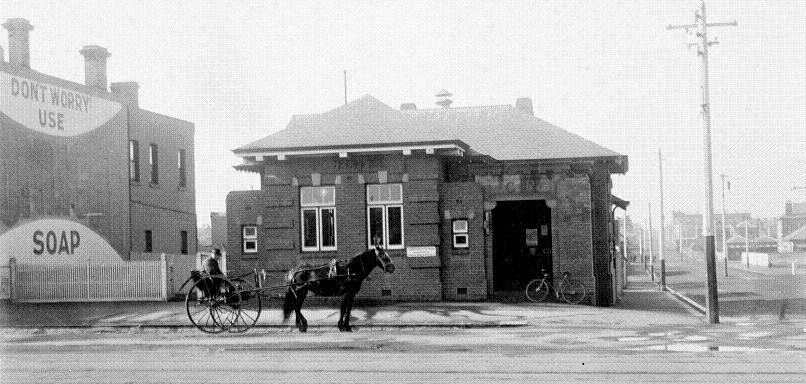
North Carlton Post Office
After nearly 100 years of delivering letters and parcels, the North Carlton Post Office in Rathdowne Street closed its doors at midday on Friday 14 October 2022, and re-opened the following Monday at 607 Lygon Street, Princes Hill. The large brick building at 546 Rathdowne Street, on the corner of Richardson Street, was the first purpose-built post office in North Carlton. The vacant land was acquired by the Commonwealth Government in 1911 and plans were drawn up in 1912. While no report of the official opening date has been located, the post office was in operation by 1913. Over the years, the building has undergone several changes, reflecting developments in postal and telecommunication services. In the original floor plans, the two enclosed booths either side of the main façade are designated as telephone boxes, in the days when public telephone calls were operated-connected. External telephone boxes were added decades later to the picket-fenced area north of the building, and subsequently removed as the demand for public telephone access waned. The external brickwork has been painted over and is now a cream colour. In recent years, steps and a ramp for disabled access have been added to the front entrance.1
The need for postal and telegraph services in the rapidly-growing suburb of North Carlton was demonstrated decades before the new post office was built. In February 1888, a deputation comprising Mr Gardiner (MLA) and Councillor Mills called on the Postmaster General to open the Rathdowne Street telegraph station as a matter of necessity. The first North Carlton post office premises recorded in Sands & McDougall in 1888 was a shop at 783 Rathdowne Street, near the Macpherson Street corner. Miss Eliza White was the postmistress and she shared the premises with Mrs G. White, a stationer. In the early days of Carlton, it was not uncommon for postal services to be operated in conjunction with other businesses, such as stationers and newsagents. Miss and Mrs White remained at the address until 1892, when both moved to 797 Rathdowne Street, a short distance north of the Macpherson Street corner. The next move occurred in 1896 to 428 Rathdowne Street, on the east side, and the last recorded listing was in 1913.2,3
Elsewhere in Carlton, the post office at 146 Elgin Street was built in 1883 and officially opened in April 1884. The Carlton Post Office was closed in 2021 and postal operations were moved to the retail area in Lygon Court. The South Carlton Post Office, at 113-119 Lygon Street, was officially opened in April 1964 and is the only purpose built post office remaining in Carlton.4,5,6
Notes and references:
1 Digitised plans and historic photos of the North Carlton Post Office building are available on the National Archives of Australia website.
2 The Argus, 2 February 1888, p. 11
3 Building occupancy information has been sourced from Sands & McDougall directories and Melbourne City Council rate books.
4 The Age, 28 July 1883, p. 6
5 The Age, 2 April 1884, p. 5
6 The Sun, 18 April 1964, p. 2
Is it Curtains for the Curtin?
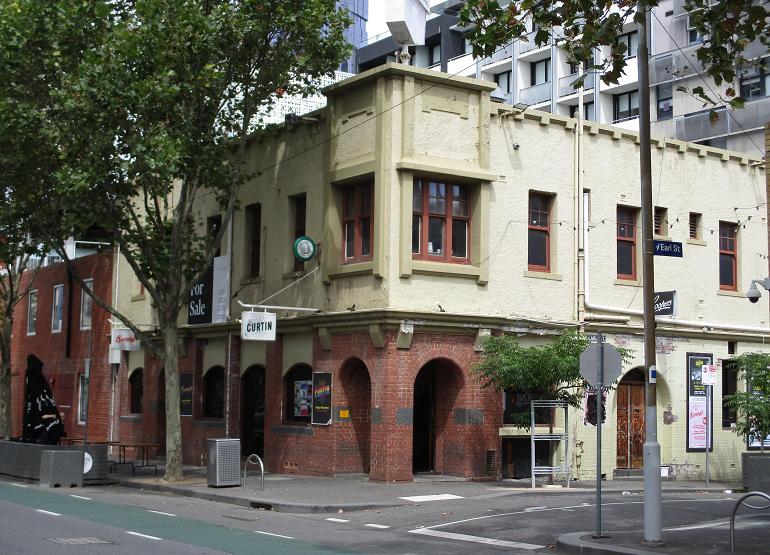
Image: CCHG
John Curtin Hotel, corner of Lygon and Earl streets, Carlton
Another historic Carlton hotel – the John Curtin in Lygon Street – has been sold recently and is facing an uncertain future. The hotel's licence expires in November 2022 and, depending on the intentions of the successful buyer, the popular watering hole for trade unionists, politicians, journalists and students could be serving its last drinks before the end of the year. The hotel takes its name from John Curtin, Australia's wartime Prime Minister from 1941 to 1945 and, being conveniently located opposite Trades Hall, it has a long association with the trade union movement and the Australian Labor Party. The hotel's present name is a more recent re-branding from the early 1970s. It was known as the Lygon Hotel for the greater part of its long life and was licensed to Michael O'Meara in 1859. The original early Victorian brick hotel building was replaced, or substantially remodelled, in the early 20th century, with the addition of a distinctive archway façade.
The names "John Curtin" and "John Curtain" – both Irishmen associated with politics and Carlton hotels – are sometimes confused. John Curtain was a 19th century politician, business entrepreneur and publican. He was a Melbourne City Councillor and Member of the Legislative Assembly, and licensee of two Carlton hotels – the old Leicester Hotel in Leicester Street and, most notably, Curtain's Hotel (now Ballers Clubhouse) on the corner of Elgin and Drummond streets. At one stage, John Curtain owned dozens of business and residential properties in Carlton, but he was forced to sell many in the 1880s to cover his business debts. John Curtain died in straitened financial circumstances in 1905. His name is commemorated in Curtain Street and Curtain Square in North Carlton.
John Curtin, former trade unionist and Prime Minister of Australia, died in Canberra in 1945.
Note: Hotel building and licensing information has been sourced from the Australian Architectural Index, Melbourne City Council rate books and contemporary newspaper accounts.
More Information:
John Curtin (1885-1945)
John Curtain (1835-1905)
2021
The Greening of Hughes Street
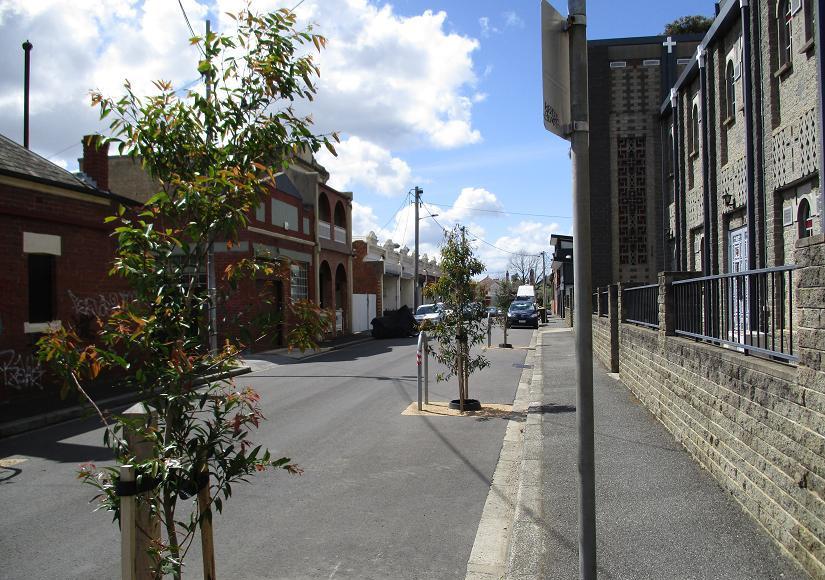
Image: CCHG
Hughes Street, North Carlton, looking east towards Drummond Street
Hughes Street in North Carlton has had a landscape makeover, with new trees and garden beds planted by City of Yarra. Hughes is one of the lesser known small streets of North Carlton, running between Drummond and Lygon streets and backing onto Pigdon Street. Even those unfamiliar with the street location could not help but notice the ornate Greek Orthodox Church that stands on the corner at 998 Lygon Street.
Hughes Street had its origins in 1871, when John Hughes purchased six crown allotments in the area bounded by Lygon, Pigdon and Drummond streets. The street was slow to develop, with the first house built on the north side by James Macpherson in 1875. This was a two storey house described as "brick, 6 rooms, bath, balcony, verandah" in the rate books for 1876, and the address later became 24 Hughes Street. There was a ten year gap in building activity until 1886, when seven cottages were built by John Calman, to the design of architect W.A. Fettes. These cottages, later numbered 8 to 20, filled in eight of the ten building allotments on the north side of the street, with vacant land on either side of the original two storey house. The cottages were advertised for sale in 1887 and again in 1902. Hughes Street had to wait nearly three decades for one of the two remaining building blocks to be filled. In 1929, a brick factory was built for the Matar Brothers, tobacco manufacturers, at 26 Hughes Street. This became a clothing factory, Les Couture Pty Ltd, in the 1960s. The north side of Hughes Street is now entirely residential. With limited open space available on their properties, local residents have created a communal garden in the back lane, which is shared with the corresponding houses in Pigdon Street. 1,2,3,4,5,6,7
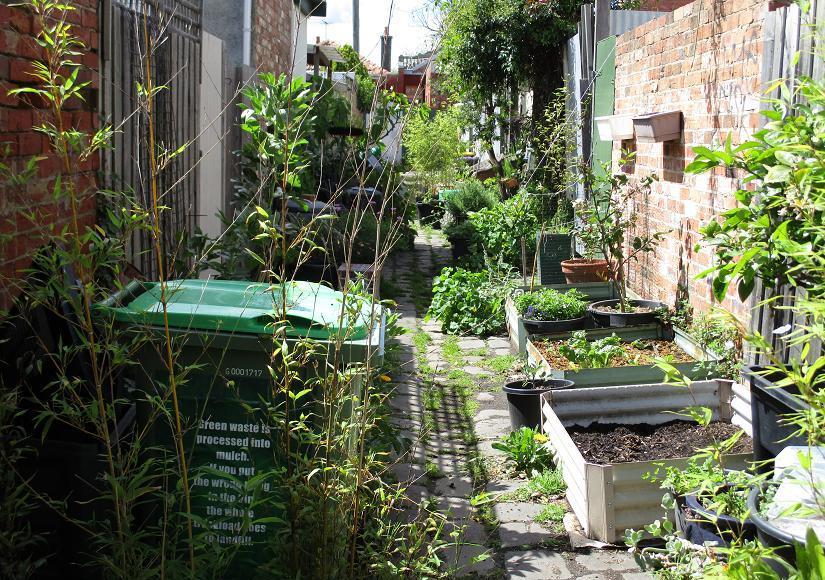
Image: CCHG
Communal garden at rear of Hughes Street
The south side of Hughes Street, where Saint John the Baptist Greek Orthodox Church now stands, followed a different historical path. This land was considered part of Lygon Street for rating purposes and has remained so. George McCahon built a shop and residence fronting Lygon Street in 1883, and another on the Hughes Street corner in 1891. Mr McCahon was a grocer by trade and his son, also named George, operated a wood yard at the rear of the premises. Running concurrently with the business, the site was a temporary home for the Princes Hill Presbyterian Church, where services were conducted from the early 1890s through to about 1910, when George McCahon senior died. This was the first documented use of the site as a church, decades before the Greek Orthodox Church was built. The site was acquired and occupied by Wilson & Frazer Pty Ltd, fuel and produce merchants, in the 1920s. In April 1938, there was a serious motor accident in which a truck crashed into the corner building, bringing down powerlines and part of a brick wall. The two men in the truck cabin were trapped for some time under tons of straw, hay and bricks. Both were seriously injured, but they survived the crash. Ownership of the site changed again in 1966 and by that time the land had been vacant for at least two years. The new Greek Orthodox Church, built in 1968, is considered historically and architecturally significant for its contribution to post-World War 2 European immigrant communities. 8,9,10,11,12,13
Notes and References:
1 Crown titles volume 430, folios 937, 938, 939, 943, 944, 945
2 Australian Architectural Index, record no. 78039
3 Australian Architectural Index, record no. 79185
4 The Herald, 18 April 1887, p. 2
5 The Argus, 13 December 1902, p. 14
6 Building Application Index
7 Australian Architectural Index, record no. 78741
8 Australian Architectural Index, record no. 79730
9 The Age, 26 December 1891, p. 12
10 Certificate of title volume 4537, folio 235
11 The Age, 16 April 1938, p. 11
12 Certificate of title volume 4537, folio 235
13 The Yarra Heritage Database cites a build date of circa 1968,
while the Melbourne City Council rate book for Victoria Ward records the site as vacant land until 1970.
Sands & McDougall directories list the church at the site from 1968.
Maria's on the Move
After more than two decades in North Carlton, Maria's Pasta has closed its retail outlet. But local residents will not have to go far to buy their fresh pasta, pasta sauces and ready-made meals. The shop has moved just across the road to 706 Nicholson Street, North Fitzroy, the original home of Maria's Pasta dating back to 1985.
Maria's Pasta made the move to larger premises at 677-679 Nicholson Street, North Carlton, in 1995. The large brick building has had several incarnations during its 135 year history. It was originally built by James Spicer, staircase maker, as a joinery factory in 1886. James Spicer died in 1893 and the factory building was bought by William Angliss, a local butcher who went on to build a business empire in the meat trade. Under his ownership, the factory became a printing works and, in 1898, it was home to Madame Demaret & Company, publisher of dressmaking patterns and the "Glass of Fashion" journal. Madame Demaret's patterns were widely sold, with agents appointed in Victoria and interstate. From 1906 to the early 1930s, brewing was the business of the day. The Stacey Brewing Company was well known for its non-alcoholic beer, favoured by temperance advocates, while Bux Brewing had its signature "Stockade" brand, made from Tasmanian hops. Then there was a succession of motor tyre businesses from the mid 1930s through to the 1970s – Thompson & Son Motor Tyres, the Indo Rubber & Tyre Company, and Firestone Australia Pty Ltd. The original 1880s brick structure was substantially rebuilt in 1944, following a fire that sent clouds of acrid smoke from burning tyres over the city and surrounding suburbs. A new roof and verandah were added in later years, between the last two businesses – A distribution centre for Sigma Pharmaceuticals and, more recently, Maria's Pasta. 1,2,3
References:
1 Business occupancy information sourced from Sands & McDougall directories and newspaper advertisements,
with additional information from Maria's Pasta.
2 The Argus, 8 April 1944, p. 4
3 Melbourne Building Application Index
2020
150 Years of Health Care for Children
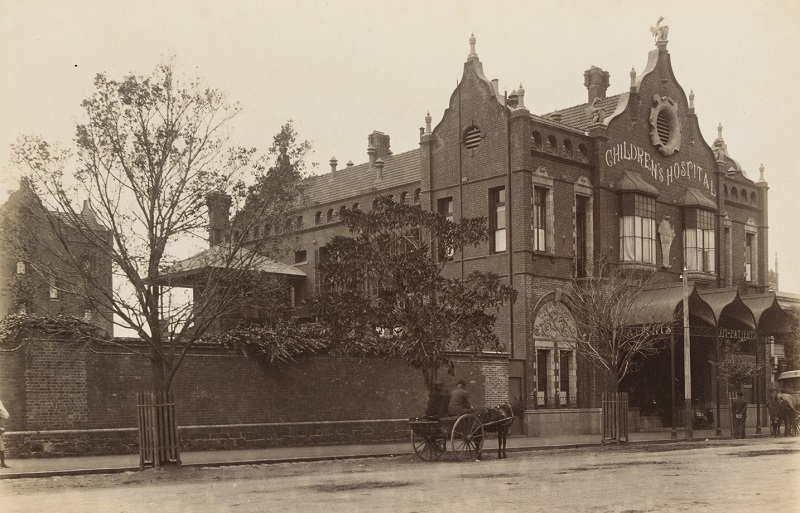
Image: State Library of Victoria
The Children's Hospital, Carlton, circa. 1900
The Royal Children's Hospital in Parkville celebrates its 150th anniversary in 2020. It all began in 1870, when medical authorities and concerned citizens recognised the need for a hospital dedicated to the care of sick children. The infant mortality rate was particularly high in inner city areas and many low income families could not afford to pay for private medical and nursing care. The "Melbourne Free Hospital for Sick Children" was established in 1870 in Stephen (later Exhibition) Street in the city. Newspaper advertisements published in The Age in October 1870 invited readers to subscribe the amount of one guinea (one pound and one shilling) to fund the hospital. The Carlton branch of the London Chartered Bank, on the corner of Elgin and Drummond streets, was one of the businesses nominated to receive subscription payments.
|
THE MELBOURNE FREE HOSPITAL FOR SICK CHILDREN 39 Stephen-street South. President: His Honor Judge Pohlman. Consulting Medical Officers: Physician, Dr. Motherwell; Surgeon, Professor Halford. Attending Medical Officers: Physician, Dr. Singleton; Surgeon, Dr. William Smith. The Institution, which is under the management of a committee of ladies, is open for out-patients on Mondays, Tuesdays, Thursdays and Fridays, at 12 o'clock. Subscribers of One Guinea are entitled to receive five letters of recommendation. Subscriptions will be thankfully received by the Treasurer, M. Buckley, Esq. (Buckley and Nunn), and by the London Chartered Bank, Collins-street and Carlton.
The Age, 6 October 1870, p. 1 |
Two years later, in 1872, the original six bed hospital moved to larger premises in Spring Street and was renamed the "Melbourne Hospital for Sick Children". With increasing demand for health care services, the hospital needed adequate longer-term accommodation. In May 1872, an application was made for a grant of land as a permanent home for the hospital. However, the only land available at the time was in Sydney Road, which was considered too far out of the city for patients and staff alike.
LAND GRANT An application was made yesterday on behalf of the Hospital for Sick Children for a grant of land as a site for an hospital. The President of the Board of Land and Works was not present, but the deputation which consisted of Mrs. Bromby, Miss Bromby, Mrs. Hugh John Chambers, and Mrs. Halford, accompanied by Mr. James (surgeon) and Mr. MacBain, M.L.A.– was received by the assistant-commissioner. The only eligible piece of ground which Mr. Hodgkinson could point out abutted on the Sydney-road, and adjoined the old show-yards of the Port Phillip Farmers' Society. The deputation would have been better satisfied with a site on the Eastern-hill, or near the centre of the city, inasmuch as they wished that the hospital should be erected in a locality which could be easily reached both by managers and by patients; but when they ascertained that every other available site was gone they said that they would take the piece Mr. Hodgkinson had indicated. The assistant-commissioner undertook to represent the case favourably to the Minister of Lands. The extent of the ground was stated to be one acre ; it is a valuable piece of land.
The Argus, 16 May 1872, p. 14
The accommodation solution presented itself in 1876, when Sir Redmond Barry sold his substantial house in Carlton. The new Hospital for Sick Children was formally opened in September 1876 and described in glowing terms in the Annual Report for that year.
The property contains altogether an acre of ground, and has extensive frontages to Rathdowne, Drummond and Pelham streets, the last mentioned of which the principal entrance faces. The grounds contain a well-arranged flower, fruit and vegetable garden, which now presents a very pretty and attractive appearance, and will greatly add to the comfort of the children. The building which is of one story, contains four wards affording accommodation for 50 in-patients. The wards are lofty and well lighted, and appear very comfortable. Their ventilation is thoroughly provided for by the introduction of Tobin's system, and the windows being almost level with the ground, allow a view of the garden. The wards lead from a large central room, which was used by Sir Redmond Barry as a billiard room, but which will now form the children's dining room. The surgeon's private room is at the left of the entrance hall, and other apartments are provided for the matron and nurses, and an excellent bathroom and lavatory for the patients.
In order that cases of accident to children may be received at any time, a casualty ward has been fitted up. Adjoining the main building another smaller structure has been erected for the accommodation of external patients, containing a large room lit from the roof, where the out patients can be attended to. Near this is situated the board-room for the meetings of the committee, while a well appointed dispensary and surgeon's room are close at hand. A washhouse has been formed from the buildings formerly used by Sir Redmond Barry as stables. Altogether the arrangements of the hospital are excellent as regards accommodation and under good management the institution cannot fail to very largely increase its present sphere of usefulness.
The Argus, 28 September 1876, p. 7
Carlton was home to the Children's Hospital (known as the Royal Children's Hospital from 1953) for 86 years, when it moved to a new purpose-built hospital in Parkville in January 1962. The ten acre site had been granted as early as 1948, but construction was delayed for some years due to lack of Government funding. In more recent times, the hospital has been completely rebuilt as a new state-of-the-art medical facility, opened in 2011.
More information: RCH 150
Where have all the flowers gone?
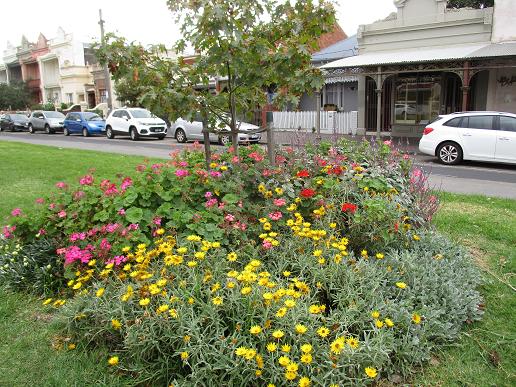
Image: CCHG
Median Strip Flower Garden in Canning Street, North Carlton, in April 2020
For the past few years, North Carlton residents have enjoyed a colourful display of flowers surrounding the recently planted oak trees in the Canning Street median strip. Alas, this has come to an end. The flower gardens were planted without Council approval and were thought to be depriving the young trees of nutrients essential to their healthy growth. The flowering plants were removed by Council staff in late April 2020. The oak trees underwent an intensive feeding regime during winter and spring, and new street trees have been planted along the North Carlton length of Canning Street.
The Canning Street median strip was originally created in 1927, with plantings of palm and poplar trees. Into the 21st century, many of the poplar trees were in poor condition and had to be removed for safety reasons. The replacement oak trees were planted in the spring of 2016 and, in the coming spring of 2020, will hopefully be showing healthy signs of new growth.
Related item: The Poplars of Canning Street
Nicholson Street Tram Track Upgrade
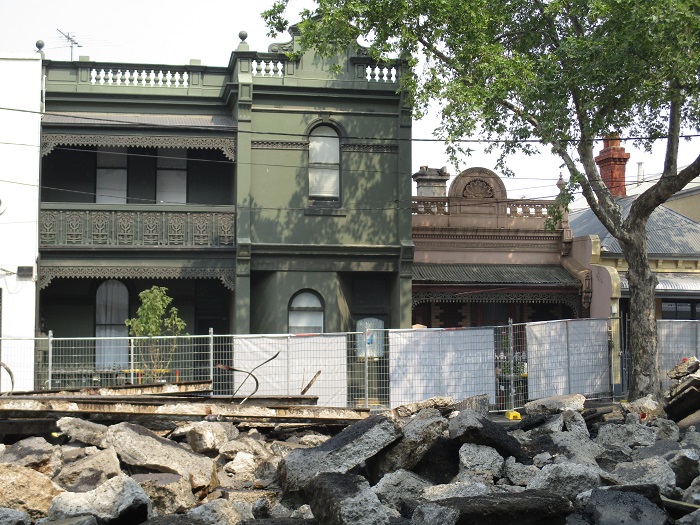
Image: CCHG
Tram Track removal in Nicholson Street, North Carlton, January 2020
The Nicholson Street tram route, which services both Carlton and North Carlton, had a major upgrade in January 2020, with the installation of accessible tram stops for the entire length of the street. The final stage of the project involved removing and replacing the tram tracks between Princes Street and Brunswick Road, to join up with the previously upgraded Carlton and Brunswick sections. Nicholson Street residents had to endure noise, dust and inconvenience during the project, but they have been promised an improved tram service, with better and safer access to tram stops.
The Nicholson Street tram route was originally opened as a cable tram service in August 1887. The cable winding house, which still exists, was located on the corner of Nicholson and Gertrude Streets, opposite the Carlton Gardens. The tram sheds, now home to the bus company Transdev, were located in Nicholson street, North Fitzroy, near Park Street. Melbourne's cable tram service was gradually run down from the 1920s and the Nicholson Street route was replaced by buses in October 1940. Electric powered tram services were re-instated in Nicholson street in April 1956 and have continued to serve local residents and businesses for over six decades.
For more information on trams, go to the Travelling in Carlton page.
Turning on the Waterworks at Carlton Gardens
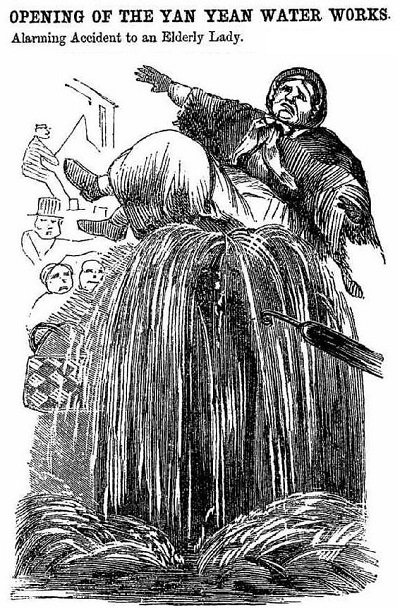 Image: Punch, 31 December 1857, p. 6 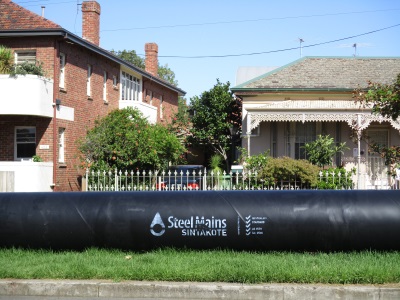 Image: CCHG Water Main Renewal Project Canning Street, North Carlton, February 2020
Notes and References: |
Water security is a global issue and in Melbourne we are fortunate to have good quality drinking water available on tap. In the early days, the city's water supply was precarious, particularly during the summer months. Rainwater had to be collected, bores were sunk and water was pumped and carted from the Yarra River and other water courses. As the town's population grew, so did the demand for water and the only long term solution was to construct a reservoir to hold water and convey it via a system of pipes to the city. Yan Yean, north east of Melbourne, was chosen as a suitable site, with water drawn from the Plenty River. Construction took place over four years, commencing in December 1853, and it was a major engineering project for its time. The cast iron water pipes from the reservoir were laid through bushland to the outskirts of Melbourne, then followed the course of what later became St Georges Road to join Nicholson Street near Yorke (later Lee) Street and thence to the Carlton Gardens. 1,2 In December 1857, when the suburb of Carlton was just a few years old and North Carlton was yet to be created, the main valve was installed at the Carlton Gardens in readiness for the official opening of the Yan Yean Waterworks. As the hot days of summer arrived, the citizens of Melbourne eagerly awaited their new water supply, as announced by The Age on Christmas Eve:
In the same edition of the newspaper, The Age made a "glass half empty" comment that the stand pipes, which had previously supplied water to parts of the city, were to be removed "to induce the owners of property to lay the water on to their houses". This, as claimed by the The Age, had led to water carriers doubling their price from three to six shillings a load, and the burden of cost would fall on tenants. The Age concluded: "As it is, the completion of the Yan Yean water works instead of being a boon will prove a very great source of annoyance to most of the inhabitants of Melbourne." 3 The last day of 1857 dawned and by noon an estimated crowd of 7,000 had gathered at the Carlton Gardens. The Governor of Victoria, Henry Barkly, was unable to attend due to disposition, and the honour of opening the main valve went to Major-General Macarthur, the Commander-in-Chief of Her Majesty's Forces in Australia. Other dignitaries included Dr. Greeves, President of the Water and Sewerage Commission, Bishop James Palmer, Premier William Haines, Mayor Thomas Smith, Justice Redmond Barry and engineer Matthew Bullock Jackson, who superintended the whole scheme. 4 The Argus reported the occasion in matter-of-fact detail, while The Age, one again, took a "glass half empty" approach. The reporter complained about the lack of accommodation for the press, and the poor organisation of the event and crowd control of the procession that followed through the city:
A few days later, The Age acknowledged one positive outcome of the improved water pressure and reported that: "The Superintendent of the Melbourne Fire Brigade informs us that the nozzles of the delivery pipes have already been enlarged, so as to meet the great pressure of the Yan Yean waters." 6 A little-known consequence of the waterworks project was that the land bounded by Station, Nicholson, Elgin and Reilly (Princes) streets in Carlton was reserved from sale for use as a tramway terminus. Matthew Bullock Jackson proposed that the wooden tramway, built to aid pipe-laying from Yan Yean to the Carlton Gardens, could be converted into a locomotive railway line for carrying goods and passengers. This would open up Yan Yean and locations along the way to settlement and sightseeing traffic. It was a bold idea and no doubt Jackson had the engineering skill and ability to make it happen, but funding was lacking and the project never went ahead. The land was released for sale in 1863 and, as a result, the buildings on the east side of Station Street between Elgin and Reilly (Princes) streets were of later construction than those on the west side. 7,8 Fast forward to mid-2019 and the time came to renew the water main servicing both Carlton and North Carlton. The existing water main running beneath Nicholson Street was 140 years old – not quite as old as the Yan Yean pipes – and was nearing the end of its operational life. The new – and larger diameter – water main was installed beneath Canning Street, from Faraday Street through to Park Street, and involved tunnelling under the major intersections at Elgin and Princes streets. Apart from renewing the pipes, the water main had to be re-located as the new tram superstops in Nicholson Street would make it difficult to access the existing pipes for essential maintenance. Life was much simpler in the 1850s, when public utilities did not have to compete with each other for space. However, we do enjoy the health and benefits of modern living and clean water. 9 |
Calling All Gobles
Are you related to George Frederick Goble? If yes, CCHG would like to hear from you.
George Frederick Goble was born in Essex, England, in the early 1800s. He lived in England, America and Australia, and he spent his final years in the Melbourne suburb of Carlton. George married Emma Anne Faulden (Foalden) at Longford, Tasmania, in 1838 and they had six children, all born in Launceston, Tasmania. The births of four of these children were registered with the names Emily Ann, Geofred, John William and Marantheo Eliza. George Goble died at Wharton Terrace in Drummond Street, Carlton, on 13 April 1888 and he was buried in an unmarked grave in Melbourne General Cemetery. He shares the grave with John Hely, who died in 1887.
As a veteran of the American Civil War, George Goble may be entitled to a grave marker from the American Veterans' Administration. The Melbourne General Cemetery requires the permission of a living descendant for a grave to be altered. Please contact CCHG if you can assist.
2019
Congratulations Judith
Photo: CCHG
Judith Biddington (left) receiving her Award of Merit from Richard Broome
On Tuesday 21 May 2019 Dr Judith Biddington, founder and inaugural president of the Carlton Community History Group (CCHG), was presented with of an Award of Merit by the Royal Historical Society of Victoria for "meritorious service" to a historical society. Thirteen years ago, Judith identified the need for a local community history group in Carlton and set about to achieve this goal. She placed a notice in the Carlton Library and this lead to the established a pattern of monthly meetings with presentations by people with some light to shed on the experience of growing up and living and working in Carlton. Within a year the Carlton Community History Group was meeting regularly, became incorporated, and achieved affiliation to the Royal Historical Society of Victoria.
From the start her approach has been to engage with local people directly, including shopkeepers, teachers, potential speakers for meetings, long term residents, representatives of organisations like churches and our local mosque, gathering history on the ground, and most importantly, involving and enthusing people. Along with several other hard working and dedicated members, Judith began recording a series of interviews with present and former Carlton residents. These oral histories are now to be digitised and made more accessible. She also began a series of special events and regular publications produced by the CCHG, commencing with her own booklet "Some Women of Davis Street : 1891 and 2008". Judith edited Des Norman's book "Through the eyes of a child : A street in Carlton 1939-45 and contributed a chapter to CCHG's latest publication "Carlton Voices", launched in October 2018.
Judith has also written several articles and book reviews for the CCHG website and these reflect her eclectic range of interests.
The Bassos of North Carlton : A Love Story and a Full Life
Carlton Footballers Who Fought and Died in the Wars
A Russian Visitor : Aleksandr Leonidovich Yashchenko
The Trades Hall : Part of our History
Women and War : Two Case Studies
Postscript: Judith Biddington died on 13 December 2023, aged 90 years.
Enoteca Sileno
Gastronomia Dal 1953
The 2019 auction of the Enoteca Sileno at the southern end of Amess Street, North Carlton, breaks one more link with the heyday of Italian Carlton in the 1950s and 1960s, but at the same time highlights the way in which so many different aspects of Italian culture have been adapted to, and merged with, the Australian mainstream. Amess Street has always been mostly residential but this double-fronted building at nos. 21-3 is an exception.
As early as 1897 it appears in Sands & McDougall's business directory as Condon's woodyard, conveniently situated with lanes beside and behind it. Within a few years it had become Condon's dairy and remained so for almost fifty years. No cardboard cartons or glass bottles then. Milk was bought as required and carried home, often by children, in a billy. Jack Ward, who as a child in the 1940s lived just round the corner in Fenwick Street, helped out at Condon's after school by rolling the milk cans up the bluestone lane. He was paid in milk. After 1947 the dairy changed its name several times. For a while it was called the Princes Park Dairy, which was where local cows were sent to graze, returning down Amess Street and entering no. 21 through its big front doors. They were milked at the back of the building where the two last rooms have a concrete floor and a slope to facilitate washing down.
By the late 1950s the dairy had closed and the front room was rented by Italian migrant Luigi "Gino" Di Santo who arrived in Australia in 1952. With an extensive background in business and a long family history in wine and food he quickly saw the potential in Australia for Italian products. In 1953 he was the first Italian immigrant to have a stand at the Home Show in the Melbourne Exhibition Building displaying a Borletti portable sewing machine, Venetian glass from Murano and Italian cigars and cigarettes. The importing business quickly diversified into baby food, mineral water, preserved vegetables, olive oil, balsamic vinegar, wines and liqueurs, featuring goods in demand with the booming Italian population and previously unknown to Australians but soon to become popular.
As the business grew, Gino rented more and more of the space. It became a large-scale operation. His daughter Rosemary remembers that:
"We used to unload shipping containers, with our imports, which were diagonally parked on the road occupying more than half of the street with rollers sending down cartons into the building. These cartons were unloaded using conveyor rollers and ferried throughout the building on trolleys racing up and down the corridors into the appropriate storage spot. The containers were hand unloaded there for about 20 years. Before containers many shipments were brought to Australia in wooden crates."
21 Amess Street served other purposes as well. At one point newly-arrived Italian men were renting sleeping space at the back of the building and the dairy cool store was converted into a shower room. There was also a jam factory at the back of the building run by a Mrs Hoult. No. 23 was gradually incorporated into the main space, housing offices and providing additional storage. The facade had been renovated by the then owners, who also owned number no. 19, and who probably also added the concrete slab outside the front door; Ferdinando Busatta was a concreter by trade. The bluestone foundations of the original cast-iron fence can still be seen beneath the slab.
By the early 1980s the business was gradually changing its focus to more traditional artisan products and in 1982 Gino was able, as he had always wanted, to open a retail store, an enoteca or wine bar. His is thought to have been the first place in Australia to specialise in Italian wines and the first business to use the word enoteca in its name. Customers came from far and wide and many still remember the cluttered treasure house of goods it offered.
Gino had owned the building since 1986 but by 2004 Enoteca Sileno was ready for another major change, moving to a two storey corner building in Lygon Street, previously the Rising Sun Hotel, where today, under the proud banner Gastronomia dal 1953, it conducts wholesale and retail businesses with a wide range of Italian products as well as a cooking school. No. 21-23 Amess Street reverted to its original function as storage space until it was sold in October 2019. Many will be pleased that this historic building appears to have dodged the developer's bulldozer. The new owner intends to live there.
Information for this story has been sourced from the Enoteca Sileno website, with additional research by CCHG. The assistance of Rosemary Di Santo-Portelli is gratefully acknowledged.
Another Business Closes in Rathdowne Street
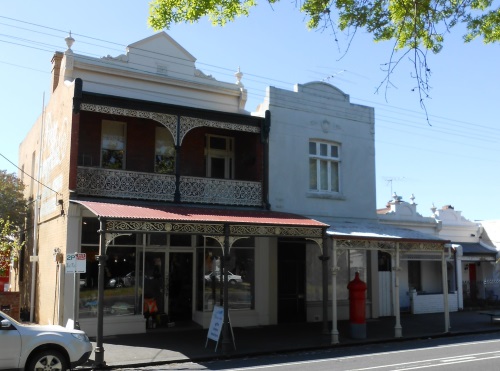
Image: CCHG
The Feathered Arbour
430 Rathdowne Street, North Carlton
The Feathered Arbour has closed in February 2019, with the expiry of the lease at its business premises. The building at 430 Rathdowne Street, North Carlton, home to the Feathered Arbour for the past six years, was once owned by motor mechanic Martin Shelley, who also operated his business at 420 and 520-522 Rathdowne Street.
2018
Farewell to Mangala
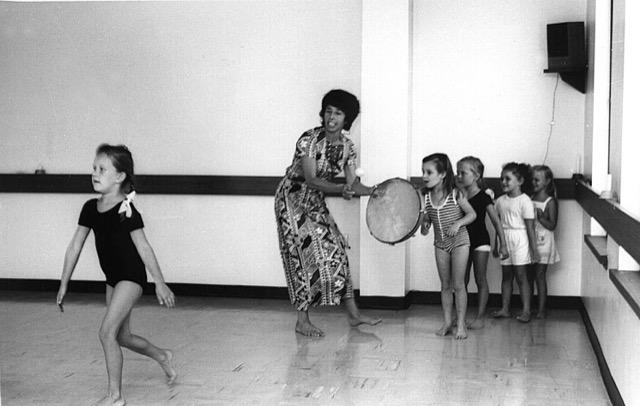
Image: Courtesy of Mangiamele Family
Dorotea Mangiamele at Mangala
The atmosphere at the recent annual production by the Mangala Studios of Yoga and Creative Dance was reassuringly familiar. The theatre was packed with family supporters looking forward to another evening of quirky entertainment. Paper lanterns were laid out in the foyer for the usual just-after-dark walk through adjacent parkland. Peter Hockey was at the microphone, ready to narrate the storyline which would draw together the dances of a wide range of age groups. The youngest dancers were still at that age where they couldn't resist the temptation to rush to the edge of the stage and peer into the audience, looking for their parents so that they could wave to them. The oldest performers, some of them 19 or 20, took an altogether cooler approach, as one would expect of veterans of, in some cases, ten such productions. But the familiarity fell away when the performance finished and Peter announced that it had been the 37th - and the last. After almost 50 years at the corner of Grattan and Lygon Streets, Mangala is leaving Carlton and restructuring. Parking and traffic problems are part of the reason. Sadly, this move comes at the same time as the loss of another local institution, the Lygon Food Store, just a few minutes away.
The success of this dance studio over so many years with students of all ages can be ascribed to its very relaxed approach. Yoga forms an integral part of the program for older students and the emphasis is on individual responses to music, not on the learning of rigid routines. No pointe shoes here! Everyone dances bare-footed. Today the studio is run by Peter and Sue Hockey and Claudia Mangiamele. Peter also offers tuition in Tai Chi. The women, now in their sixties, are daughters of Dorotea Mangiamele, who founded the school in 1970, and have been involved with it since they were teenagers. They have another important link to Carlton. Their father was Giorgio Mangiamele, a popular family photographer for Italian families in the 1960s and 1970s, but more importantly director of a number of ground-breaking films dealing with the experience of Italian migrants. The best known of these, Clay, was chosen to compete at the Cannes film festival in 1965.
Related Item: The Side Window
The End of an Era for Community Health in Carlton
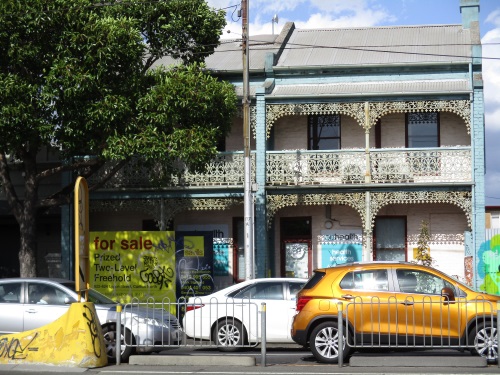
Image: CCHG
622 and 624 Lygon Street, North Carlton
Former Home of Carlton Community Health Centre
The Carlton Community Health Centre closed in November 2018, bringing to an end 39 years of community service. The centre first opened its doors on 1 October 1979 in a pair of terrace houses at 622 and 624 Lygon Street, North Carlton, near Princes Street. During the intervening years, the health centre has seen changes in the demography of its client base and the delivery of services, within the broader context of administrative, political and social changes. North Carlton was originally part of the City of Melbourne, but the reorganisation of municipal boundaries in the 1990s saw the service transferred to City of Yarra. The Carlton, Collingwood and Fitzroy Community Centres amalgamated as North Yarra Community Health (NYCH) in 1994.
As with many enforced amalgamations, the three centres did not always work together in harmony, and Carlton had its own problems with administration and internal politics. Missionaries, Radicals, Feminists, written by Hamish Townsend and published in 2012, gives a lively account of North Yarra Community Health's sometimes turbulent history. The book is available at Carlton, Collingwood and Fitzroy libraries. You can also view an e-copy at:
https://croakey.org/wp-content/uploads/2018/11/MissionariesRadicalsFeminists-2.pdf
Vale Frank Del Monaco
20 June 1943 2 September 2018
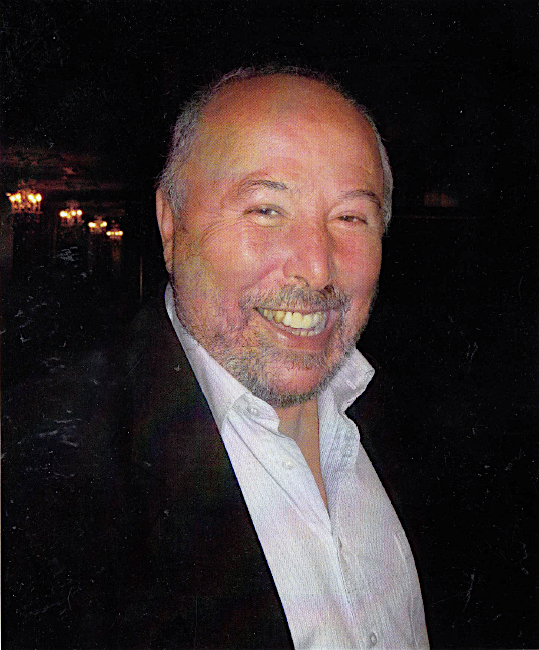
Image: Courtesy of Del Monaco Family
The Del Monaco name is one long associated with the family clothing business begun in 1938, on the corner of Faraday and Lygon Streets, Carlton. The family name features, for instance, in the book Carlton: A History (ed. P. Yule), where the family also played a role in the establishment of the iconic La Mama Theatre, set up in the building behind the Del Monaco shop.
Frank worked for many years in the family business, and was heavily involved in local business and Italian community activities, remaining passionate about the history of Lygon Street, even after the end of the family business. He was a regular at CCHG meetings from its beginnings in 2006-07, until distance and poor health restricted him to occasional telephone contact with various members on topics that still engaged him.
He was devoted to his family, with his four brothers, and five chidren surviving him, having lost one son earlier.
La Mama up in Flames
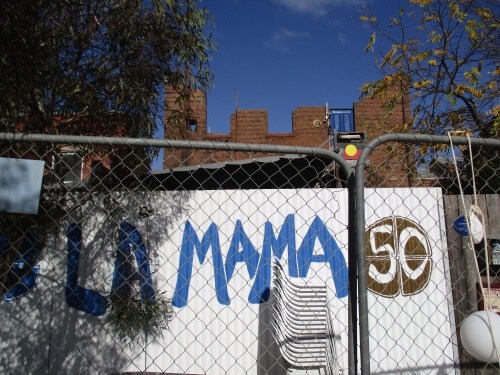
Image: CCHG
The Aftermath of the Fire in 2018
Carlton residents woke to the shocking news that La Mama Theatre in Faraday Street was gutted by fire in the early hours of Saturday 19 May 2018.
The innovative theatre was founded by Betty Burstall in 1967, in the style of La Mama in New York. The small two-storey building, once owned by the Del Monaco family, was a printing workshop, and an underwear and shirt factory before its transformation into an intimate theatre space. Betty Burstall, the "Mama" of La Mama, died in 2013.
In the theatre tradition of "the show must go on", Saturday night's performance of Bully Virus went ahead at the alternative venue of the Kathleen Syme Library & Community Centre, on the corner of Faraday and Cardigan Streets.
Related item: Betty Burstall 1926-2013
Goodbye Bridget
Bridget Kinsman (née Ballot), beauty therapist of Newry Street, North Carlton, lost her fight with cancer and died on 16 May 2018. She will be remembered as a gentle and caring soul, and will be sadly missed by her family, friends and clients. Bridget opened her salon Carlton Beauty Care in 1995, in a quaint two storey building on the corner of Newry and Henry Streets. Newry Street was not a prime location for a business, compared to the main shopping area of Rathdowne Street nearby, but it worked for Bridget. Word got around and her client base grew. She never had to advertise her services because the recommendation of a satisfied client was worth more than a thousand dollars of advertising. While other businesses came and went, Bridget's was one of the longest running to continuously occupy the building.
Bridget Kinsman (13 August 1968 - 16 May 2018) was farewelled at St Peter's Eastern Hill on 24 May 2018. CCHG extends its condolences to her husband Jeff and their two sons.
Note:
The shop at 119 Newry Street was built in 1881 by W. Hearndon. It has had a variety of uses over the years, including a fancy repository, tinsmith and bootmaker and repairer.
A Host of Golden Daffodils
I wandered lonely as a cloud, that floats on high o'er vales and hillsWhen all at once I saw a crowd, a host of golden daffodils
William Wordsworth, 1770-1850
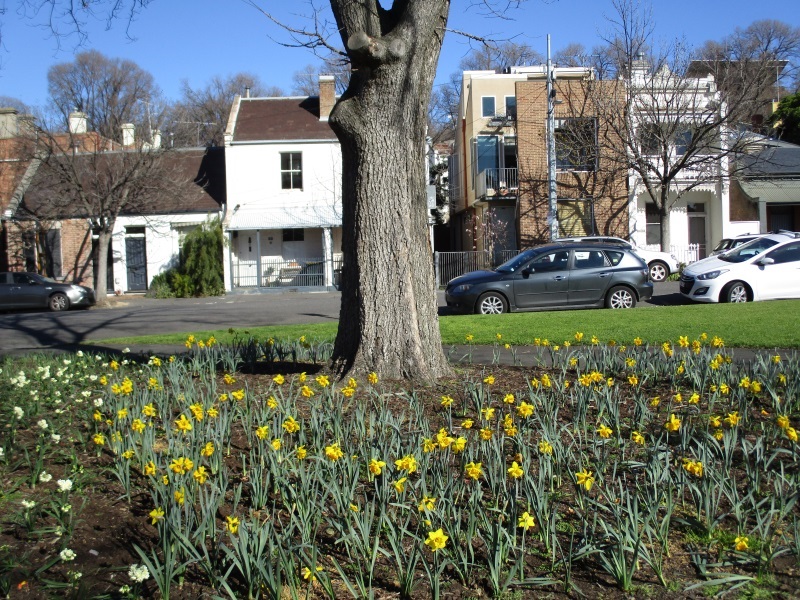
Image: CCHG
Daffodils in Murchison Square Carlton
The flowers that once inspired Wordsworth's poetry have finished blooming in Macarthur and Murchison Squares in Carlton, but they will be back again. The bulbs were planted by Melbourne City Council in autumn 2018, following a successful trial planting in the Fitzroy Gardens, East Melbourne, in 2016. The daffodils are expected to provide a colourful winter display for the next five years.
The squares of Carlton - Argyle, Curtain, Lincoln, Macarthur, Murchison and University - are the topic of our August 2018 newsletter.
And So To Bed
The boutique Milly Sleeping closed in February 2018, after more than 12 years in Carlton. The business at 157 Elgin Street, a small two storey shop with a narrow staircase, began in 2005. Mother and daughter team of Janette and Leah Muddle have supported local designers and stocked an eclectic range of clothing and accessories. "Milly Sleeping" was not, as might be expected, named after the two resident cats, which were sometimes seen sleeping in the front window. It was named after a painting by Ernst Kirchner.
Nearly 100 years ago, in September 1919, a very different style of business was transacted at 157 Elgin Street. Joseph Nolan, a hairdresser, appeared in Carlton Court on a charge of having used his premises for gaming purposes between 10 July and 1 September 1919. His was one of several local businesses raided by police and a search yielded the incriminating evidence of betting tickets and marked money. Nolan pleaded guilty and was fined £40, with £3 costs.
Reference:
The Argus, 6 September 1919, p. 17
2017
The Good Doctor
Serge Liberman
1942 - 2017
Dr Serge Liberman, medical general practitioner to a generation of people in Carlton, Brunswick and other inner suburbs, died on 22 December 2017. Here are thoughts and recollections from some of those for whom he was a treasured doctor, friend and writer.
Judith Biddington: There are many skilled doctors and writers in our community, but most don't have necessarily have skill in both areas. Serge Liberman did, he was a good doctor and a good and interesting writer. In addition, as a humanist and humanitarian, he had great people skills. No wonder people in Carlton followed him up to Brunswick when he moved from one suburb to the other, or flocked to his talks when he gave them. Serge had the capacity to involve you, as his patient, in what was happening to you, to explain, to answer all your questions honestly and sensibly, thereby treating you with respect. He always knew your history, even long term, over forty years for some members of our family. He was also very likeable and so many of his patients regarded him as a friend; even when they did not share his ethnicity they still enjoyed his writing and excellent scholarship. He would also have made an exceptional teacher. He will be sorely missed.
Anne Marie Lynzaat & Richard Trembath:
There are many stories I could tell about Serge Liberman who was our GP for decades. The one I shall tell comes from when he had retired, and it illustrates his compassion and empathy with his patients.
About a year after he left the Lotus Medical Centre he read the death notice I had placed in the newspaper regarding my brother in law's death from pancreatic cancer.
Anne Marie and I were both surprised and moved by the letter we received from Serge shortly afterwards.
In it he expressed his best wishes and sympathy for our loss.
He concluded with a typical dry joke that Anne Marie's unusual surname helped pick out the notice from all the others!
Shelley Marcus & Peter Tilley:
As patients of Serge Liberman in Carlton and Brunswick from the 1990's until his retirement in around 2013, my wife Shelley and I came greatly to appreciate his excellence and warmth as a GP but also his scholarly and literary interests.
He was a late-20th-century version of Anton Pavlovich Chekhov, who was likewise a doctor and master of the short story.
As a Russian-speaker and translator myself, I enjoyed our conversations on cultural matters during consultations.
Serge received the Alan Marshall Literary Award in 1980 and 1981, and Shelley and I have an autographed copy of his 2011, 836-page magnum opus, 'The Bibliography of Australasian Judaica 1788-2008'.
Serge will be much missed.
Felice Rocca:
It is a rare privilege to have the wise counsel and empathy of the same doctor from the gawky edge of early adulthood until the wistful edge of retirement.
I first went to the Lygon St clinic in the early 1970s with a throat complaint and soon found myself settling to see Serge whenever possible, following to new offices in Brunswick by the mid 1990s.
The strictly physical complaints, increasing as I aged, he dealt with smoothly and competently, and I soon found I could also trust him to advise on matters of emotional health, with the same warm efficiency.
I also discovered in his writings how deep his understanding of others could go, such as in his short story, published in The Age, of an elderly Italian widower readying to leave for Australia.
Upon his retirement in 2013 I felt a door was closing on a large part of my life. Now I know it is shut for good. Addio Serge.
Susan Crowe:
Serge Liberman was a popular doctor and you sometimes had to wait a while to see him, but he always gave you his full attention and care.
One day I was sitting in the waiting room, suffering from what I thought was the world's worst cold, when I heard a terrible hacking cough coming from the consulting room.
My symptoms were trivial by comparison with this patient, who sounded like they were at death's door.
Imagine my surprise when I discovered that the "patient" was, in fact, Dr Liberman himself.
He was obviously unwell, but he was still seeing a few patients before going home to rest.
He wrote a certificate for my time off work and, with his characteristic humour, he pushed a blank form towards me and asked if I could write a certificate for him.
I gave him the rest of the week off.
More information:
An obituary, with an overview of his life and work, appears in the Sydney Morning Herald.
As well as his medical work, Serge Liberman was a chronicler of Jewish, and also of other migrant lives, in Carlton and other parts of Melbourne, which came alive in his writings. Much of his writing output can be found at his website.
In December 2014 Serge Liberman gave a talk to the Carlton Community History Group entitled "Writing Jewish Carlton".
A copy of the talk can be found on the Academia website.
Dracula's Last Bite
and
The Canals Have Gone Fishing
and
The Canals Have Gone Fishing
Two well known Carlton businesses - Dracula's Theatre Restaurant and Canals Seafood - shut up shop in 2017. Dracula's began in Drewery Lane, Melbourne, in 1980 and moved to larger premises at 96-100 Victoria Street, Carlton, ten years later in 1990. The converted brick factory site, on the corner of Cardigan Street, was originally designed by architect P. Hudson in 1912 and built by F. Frenchman for Ross, Robbins Co., brassfounders. Dracula's final performance was on Saturday 23 December 2017.
Canals Seafood, at 703 Nicholson Street, North Carlton, celebrated its 100th anniversary in 2017. The business began as a fish and chip shop, operated by Spanish migrants Joseph and Maria Canals, in Collingwood in 1917. They moved to North Carlton in the early 1930s and took over an existing fishmonger's shop, which had been in Nicholson Street as early as 1905. Canals is a family business in the true sense, with successive generations learning the trade from their elders and making their own contribution to developing the business. Over the decades, migrants from Europe, like the Canals family, have done much to influence the Australian taste for fish and seafood. In 2017, the demand for quality seafood was greater than ever and the Canals brothers, John and Peter, chose to end on a high note and give themselves a well-earned break in retirement. The shop building was auctioned in October 2017 and a new seafood business, The Fishmonger's Son, opened in May 2018.
Update: The Fishmonger's Son moved further north to 781 Nicholson Street, North Carlton, in 2023.
Notes and References:
Building occupancy information has been sourced from Sands and McDougall directories.
Building design information has been sourced from the Australian Architectural Index and Building Application Index.
Dracula's Melbourne
The Age, 28 September 2017
 Photo: CCHG Elm Trees in Curtain Square North Carlton Looking South Towards Newry Street
 Photo: CCHG Tree Removal in Curtain Square North Carlton September 2017 |
From Quarry to Quercus
|
Vale Bea
1924-2017
It is with great sadness that CCHG notes the death at 93 years old of "Bea". Her recollections of her Carlton childhood were recorded in 2010 and provide a vivid insight into the kind of lives lived by poorer residents in what was then a vibrant working class suburb, as well as describing the effects of the outbreak of World War 2 on a young woman just finding her feet in the world of employment.
Bea married soon after the war and over the decades raised a family of four and gradually acquired the professional qualifications and experience she had missed out on when she left school at 14. Additionally, at the age of 64, she undertook an Arts degree majoring in Art History and Italian. She described those years at university as the highlight of her life. It was characteristic of her energy that, when she was interviewed at the age of 86, she was still employing an Italian tutor to work with her and a small group of friends in maintaining their language skills.
Bea spent the last couple of years of her life in an aged care home, something her daughters suggested to her with some trepidation as a temporary respite but which, characteristically, she enjoyed so much that she immediately elected to make it permanent.
Vale Bea, a full life indeed.
Who would have thought that waiting for her friend to change her stocking could have made such a difference? Read Bea's story and find out how this seemingly trivial event had a big impact on her young life.
A Fruitful Business
Good news for Rathdowne Street shoppers - the former St Clements greengrocer, which closed in February 2017, has re-opened under new management in May 2017. Senserrick, originally at 687 Nicholson Street North Carlton, has expanded its business into Rathdowne Street. Senserrick and St Clements are the latest in a long line of greengrocers that have occupied the shop at 384 Rathdowne Street since the 1930s, with the exception of a few years from the late 1940s when it was a wholesale hardware business. Longer term residents will remember the Tucci family, who operated the greengrocer's business from the mid 1950s through to the 1990s. The purchase of fruit and vegetables was often accompanied by an impromptu Italian lesson, courtesy of Francesca and Paolo. They retained ownership of the building after their retirement and the business has been continued by a succession of greengrocers. Paolo died in April 1993 and Francesca in June 2016, at the age of 90 years. Both were buried in Melbourne General Cemetery, Carlton.
The two storey shop building was sold in late 2016 and 384 Rathdowne Street is once again selling fruit and vegetables.
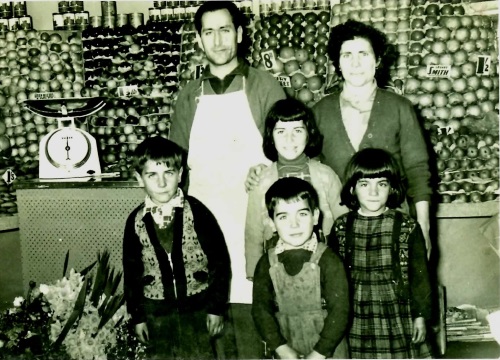
Image: Courtesy of Tucci Family
The Tucci Family in the 1960s
The Samovar Travels On
The Travelling Samovar closed in late 2016 and the former tea house entered the next phase of its history as the café Extension of Time, opened in February 2017. The new café retains a link with the Travelling Samovar and has a small selection of Samovar teas available.
The two-storey building at 412 Rathdowne Street, North Carlton, which dates back to the 1890s, was a tobacconist shop for sixty years. None of the subsequent business occupants - pastrycook, confectioner, milk bar, picture framer, noodle shop, café or tea house - can rival the tobacconist in terms of longevity. Read more about the tobacconist shop that became a tea house.
2016
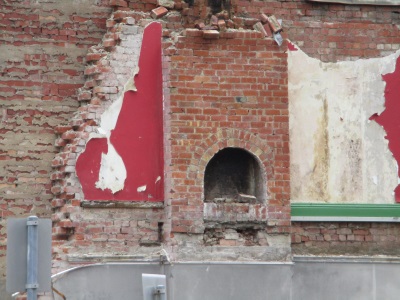 Photo: CCHG An upstairs fireplace and surrounding brickwork is all that remains of the original Carlton Inn Hotel |
|
Trendyville Revisited
At CCHG's September 2016 meeting, Dr Renate Howe gave an interesting presentation on the battle for Melbourne's inner suburbs in the 1960s and 1970s, based on the book Trendyville, which she co-authored. Dr Howe has kindly allowed CCHG to post a copy of her presentation notes on its website. If you missed the meeting, or if you would like revisit Trendyville, you can view the notes here.
The book Trendyville is available from Monash University Publishing.
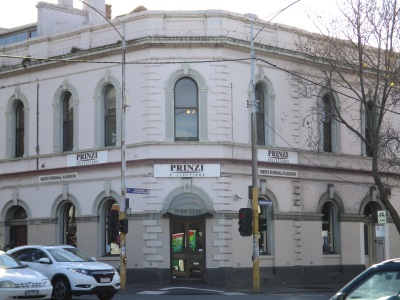 Photo: CCHG Former Bank Building Corner of Elgin and Rathdowne Streets Carlton
Notes and References: |
|
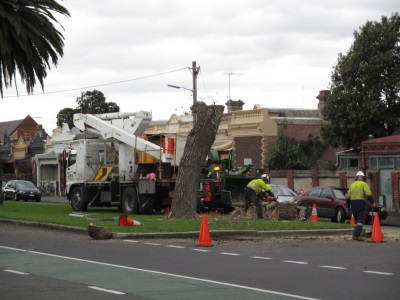 Photo: CCHG Tree Removal in Canning Street North Carlton June 2016 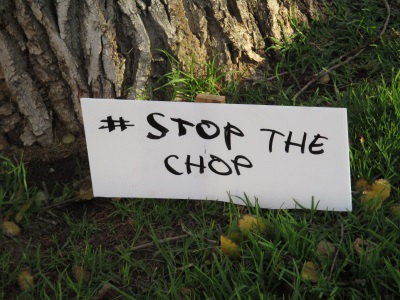 Photo: CCHG A Silent Protest
Notes and References: |
|
Tony Does Carlton
The Carlton episode of Tony Robinson's Time Walks was broadcast on ABC 1 on Friday 20 May 2016. Naturally he covers the Trades Hall and the Eight Hour Memorial. But if his points of focus are predictable, his treatment of them is not necessarily so.
The Exhibition Building? Check! But instead of dwelling on the architectural wonders, he describes the unpleasant state of the grounds in the early days and recounts a nineteenth century academic scrap over the palaeontology collection housed in the basement. Italians? Of course, but after we see a venerable espresso machine and hear Nino Borsari's son tell his father's story, a visit to Dorrit Street deftly combines the stories of Carlton's early Italian migrants, who arrived about 1890, the Viggianese street musicians, and that of Jean Lee, the last woman to be hanged in Australia. Her story is the only reference to the seamier side of Carlton's history, something of an imbalance perhaps. The program moves on to La Mama and an extended segment explores the flavour and political influence of one production from this long-running and hugely influential Carlton institution.
Inevitably in such a short program there are omissions. There is no coverage of the Jewish presence in Carlton. We see the grand terraces of Drummond Street, but learn nothing of their decline into boarding houses in the early twentieth century or of the gradual gentrification of Carlton as a whole from the 1970s.
Related items:
The Trades Hall : Part of Our History
Murder at Mallow House
Betty Burstall (Founder of La Mama)
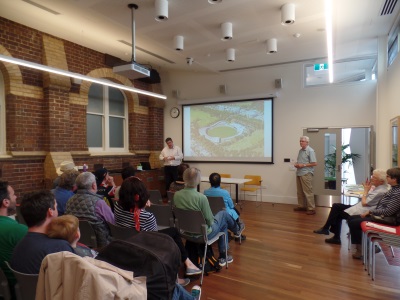 Photo: CCHG Tony de Bolfo (left) and CCHG President Jeff Atkinson |
|
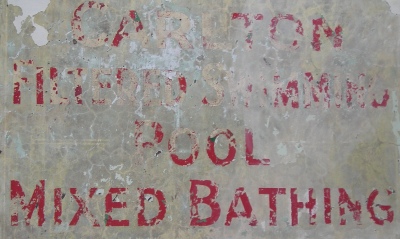 Image source: CCHG This signage recalls an earlier era, when mixed bathing was a novelty.
Notes and References: |
|
2015
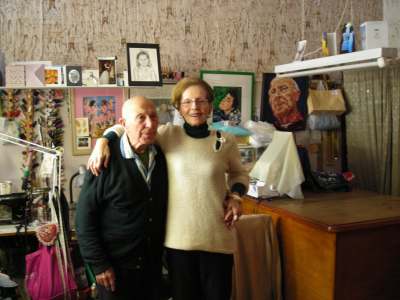 Photo: CCHG Giacomo and Gina Basso in their shop in 2012 |
|
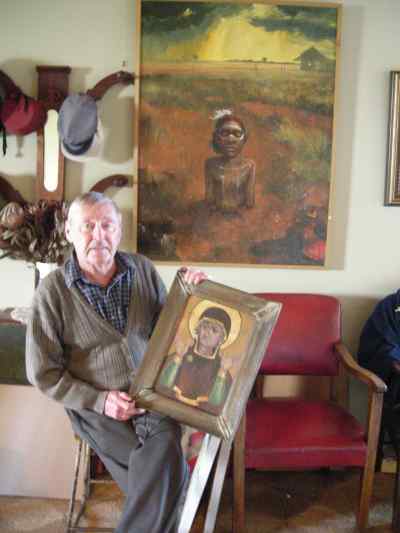 Photo: CCHG Des Norman in his studio in 2012 |
1930-2015 |
From Surrey Hills to Carlton
In August 2015 CCHG received an email asking if we were interested in a centenary souvenir booklet of the Queensberry Street Primary School. The answer was, of course, a resounding "Yes" and we have now taken delivery of the booklet, which charts the history of the school from its opening in 1881 and closure in 1932, through to its later function as the Education Department Physical Education Branch. The former school building at 224 Queensberry Street Carlton is now home to the University of Melbourne Queensberry Children's Centre. The school (S.S. no. 2365) rates only a passing mention in Peter Yule's book Carlton : a history, so the booklet will be a valuable addition to our small resource collection.
2014
 Photo reproduced with kind permission from the Bassos and CoAsIt Gina Basso (nee Costa) dancing with her husband Giacomo, soon after her arrival in Melbourne in 1953 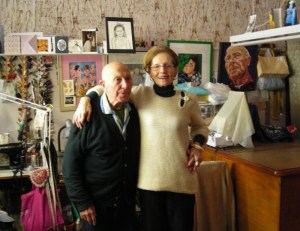 Photo: CCHG Giacomo and Gina in their shop in 2012 |
|
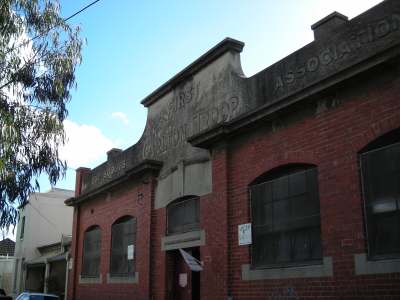 Photo: CCHG Scout Hall 12-18 Shakespeare Street, North Carlton Notes and References: 1 Melbourne Leader, 14 August, 2014 2 Property ownership information sourced from land title records 3 Building application file, BA 10595 (VPRS 11201) 4 The Argus, 21 July 1930, p. 7 5 Victorian Heritage Database 6 Properties condemned under section 56 of the Housing Act 1958 files (VPRS 1824) 7 The two-storey house at 8 Shakespeare Street was condemned by the Housing Commission in 1970, but it was declared fit for human habitation after the required repairs were completed. 8 Melbourne Times, 17 November 1976, p. 1 |
|
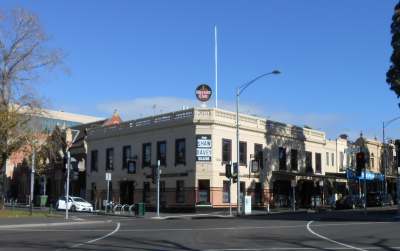 Photo: CCHG The Shaw Davey Slum (Former Pugg Mahones) Corner of Drummond and Elgin Streets, Carlton
Notes and References:
|
|
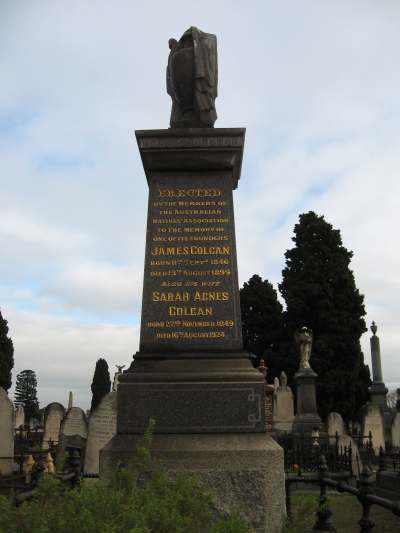 Photo: CCHG Memorial stone on grave of James Colgan (1846-1899) Melbourne General Cemetery |
|
Pat and The Poppyshop
Pat Knox, Carlton identity and owner of the Poppyshop, retired in 2014 after 47 years of business in Lygon Street. During that time, Pat has seen many changes in manufacturing and retailing, within the broader context of major social and political change in Carlton from the 1960s through to the present day. A savvy businesswoman, Pat has remained true to her ideal of selling good quality toys and gifts at a reasonable price.
Pat shared her memories of the Poppyshop with CCHG at a meeting in July 2010:
One of the things that people love about the Poppyshop, and I love it too, is that it's a happy place. People come in and they're happy, they're nice, they talk to each other. I have a lot of people who come in nearly every day, lonely people and they just come in and say "Hi" and we have a chat.
Pat Knox and the Poppyshop have made so many people happy over the years. CCHG wishes her every happiness in her retirement.
 Photo: CCHG Former Tel Aviv Dairy 183 Macpherson Street North Carlton |
|
2013
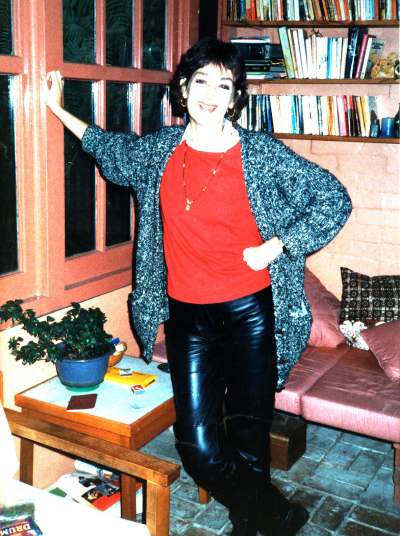 Photo: Courtesy of Ruth Bailey's family Ruth Bailey 1941-2013 |
|
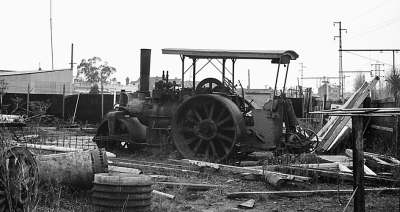
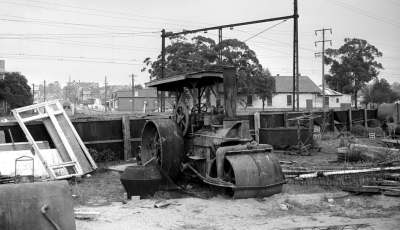 Photos: Courtesy of John E. Thompson Council Dump near North Carlton Railway Station Photographed in the 1960s |
|
Carlton's Forgotten Prison
The Carlton Community History Group congratulates member Jeff Atkinson for winning a commendation in a recent essay competition run by the Prahran Mechanics Institute.
The Prahran Mechanics' Institute is a non-profit community organisation that operates a lending library specialising in the history of Victoria. One of its objectives is to encourage and facilitate historical research, and its Short History Prize was run as a way of achieving this. Entrants were invited to submit works relating to "a history of a place or an aspect of a place in Victoria".
The winner, announced in October 2013, was John Merry of the Sandringham & District Historical Society for an entry entitled A Boyhood by the Bay : Personal Reminiscences of My Life in Sandringham in the 1940s. Two other essays were commended including Jeff's, which had been submitted on behalf of the Carlton Community History Group. His essay, entitled The Stockade : Carlton's Forgotten Prison told the story of a low security prison that operated from 1853 to 1866 in what was then bushland just north of the town of Melbourne, but which is now the built-up suburb of North Carlton.
An extended version of Jeff Atkinson's essay was published as a book in 2018. For more information, visit the Publications page.
A Tramway Terminus in Station Street
Some time ago, CCHG put out a call for help in shedding light on the origin of the name "Station Street" in Carlton. The call has been answered by Carlton resident Mike Krockenberger, who has discovered a possible connection between Station Street and the Yan Yean tramway.
A plan of allotments at Carlton, North Melbourne, Parish of Jika Jika, dated 3 August 1859, shows the area bounded by Station, Elgin, Nicholson and Neill Streets marked as "Land set apart for Yan Yean Tramway Terminus." In the 1850s Matthew Bullock Jackson proposed that a wooden tramway, built to aid pipe-laying for Melbourne's water supply from Yan Yean, could be converted into a railway line for carrying building materials and passengers. This major transport project never went ahead and the land was released for sale in 1863.
Related items:
Turning on the Waterworks at Carlton Gardens
Station Street North Carlton. What Station?
References:
Plan of allotments at Carlton, North Melbourne, Parish of Jika Jika, 1859 (State Library of Victoria)
Yan Yean : A history of Melbourne's early water supply, Tony Dingle and Helen Doyle, PROV, 2003
Squizzy Taylor in Carlton
Have you been watching Underbelly Squizzy, screened on Channel 9 in 2013? The TV series has revived interest in Melbourne's notorious gangster Joseph Leslie Theodore "Squizzy" Taylor and raised speculation about the historical content of the events portrayed. Carlton played a key role in Squizzy's demise, as the place where he spent his final hour on 27 October 1927. More information
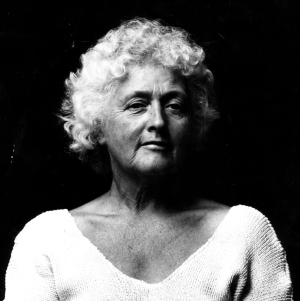 Photo: Courtesy Burstall Family Betty Burstall 4 February 1926 - 14 June 2013 | Betty Burstall |
2012
Book Launch Completes Successful Year for CCHG
On Saturday 17 November 2012 the Carlton Community History Group Inc launched their new publication Walking Along Rathdowne Street : 100 years of shopping, services and stories in North Carlton by Margaret Rich. As the acting president, Jeff Atkinson, commented, "What a fantastic book launch".
Jacki Fristacky, our new Mayor, long term Nicholls Ward councillor and CCHG patron made an interesting and thought provoking speech. However, it was very crowded. We had between 55 and 60 people crammed into the meeting room and had to turn others away, for which we apologise. We sold many books on the day and have since had to reprint 100 more copies. The Library has already sold out its initial stock, the local post office has agreed to sell the books and we have had orders from as far afield as Provence, Ireland and New Zealand. Margaret's research skills and her experience as a teacher has made what could have been a pedestrian list into an interesting read. The enthusiasm generated also reflects the community's involvement with the suburb , the street itself and its history. As we had hoped, this book has already generated more local history to add to our collection.
If you have any stories or photos about any part of Carlton we would appreciate you passing them on to us. It is a fascinating suburb, as are the people who have lived, and continue to live here. We want to preserve their contributions be they large or small. Contact us
Fancy Footwork at Carlton Hall
In 2012 Dancehouse celebrated 20 years of contemporary dance in North Carlton. The leading edge dance hub was established in June 1992 at Carlton Hall in Princes Street, formerly occupied by the Carlton Community Centre. Carlton Hall has a long association with dance, as a venue for social dances, dance classes and dance performance. But the most famous dance took place in 1877 between two political rivals, James Munro and John Curtain.1
Carlton Hall was built in February 1877, in controversial circumstances during the election campaign for the new seat of Carlton. James Munro, an avowed temperance advocate, stood against Carlton publican John Curtain. According to Michael Cannon in the Land Boomers, Munro's pro-publican opponents prevented him from hiring a hall in Carlton, so he countered their opposition by building his own hall in 14 days, at a cost of £2,000. The Burchett index confirms that James Munro registered his notice of intent to build a public hall in Reilly Street (later renamed Princes Street) on 10 February 1877. Carlton builder John Pigdon must have worked around the clock to have construction completed in time for Munro to address a meeting of electors on Monday 5 March 1877. But the claimed cost of £2,000 is in question. R.N. Henningham, in a letter to the editor of The Argus, refutes allegations that John Curtain denied Munro access to his hall in Drummond Street, and states a considerably lower construction cost of "£200 or £300" for Munro's new public hall. Was this amount closer to the actual cost of construction, or was it an attempt to diminish public sympathy for James Munro? In the end, the electorate decided in favour of Munro, who won the seat of Carlton by a narrow majority in May 1877. Four years later in September 1881 Carlton Hall, including its furniture and fittings, was sold for £1,755.2,3,4,5,6,7
James Munro honoured a pre-election promise in granting 2 years' free rent to the Carlton Mechanics' Institute, for establishment of a free reading-room, subscription library, gymnasium, and debating society. The Mechanics' Institute also collected rent revenue from tenants and other users of the hall. A separate court of petty sessions for Carlton was established in 1878, and Carlton Hall provided temporary premises until the new court house was built in Drummond Street. In keeping with its origins, Carlton Hall was home to several temperance organisations, friendly societies and masonic lodges, and served as a polling booth for state and municipal elections well into the 20th century.8,9
As a Melbourne City Council property, Carlton Hall was the focus of victory celebrations following the end of World War 2 in August 1945. With a critical housing shortage in the immediate post-war years, Carlton Hall and several other council properties offered overnight emergency accommodation for families evicted from their homes. In April 1947, the Carlton sub-branch of the RSL was granted a lease of Carlton Hall, at a rent of £260 per year. George Ward, who grew up in Henry Street, remembers following the Anzac Day march along Rathdowne Street to Carlton Hall. "Us kids would march behind and those who got to sit on the floor down the front were given food and drink." The RSL Carlton sub-branch remained at Carlton Hall until the late 1960s, when they moved to Louisville in Amess Street North Carlton.10,11,12,13
The Carlton Community Centre was established in the 1970s and offered community activities, school holiday programs and classes to residents of Carlton and North Carlton. Following the re-organisation of council boundaries in the 1990s, Carlton Hall was transferred from Melbourne City Council to its present owner, City of Yarra.
Notes and References:
1 Melbourne Times Weekly, 20 June 2012, p. 20
2 Cannon, Michael. The Land Boomers, Lloyd O'Neil, 1986, p. 243
3 Burchett Index, Reg. no. 7073, 10 Feb 1877
4 The Argus, 2 March 1877, p. 4
5 The Argus, 28 February 1877, p. 7
6 The Argus, 14 May 1877, p. 5
7 The Argus, 13 September 1881, p. 2
8 The Argus, 11 July 1878, p. 4
9 Building occupancy information sourced from Sands & McDougall and contemporary newspaper advertisements.
10 The Argus, 15 August 1945, p. 4
11 The Argus, 12 March 1946, p. 7
12 The Argus, 28 April 1947, p. 8
13 Ward, George. Henry Street and beyond
2011
From the Pacific to Carlton
Did you see the TV show "The Pacific" when the soldiers came to Melbourne for their R & R? If you had, you would have seen US marine Robert Leckie visit his girl friend in a double storey house in Rathdowne Street. Then he visited his neighbour in a lovely double fronted house in Fenwick Street.
This program has been screened all around the world showing a little piece of Carlton.
2010
La Porchetta Farewells Rocco Pantaleo
Rocco 'Rocky' Pantaleo, who died in a road accident on 26 March 2010 at the age of 53, will be remembered as an important force in the rejuvenation of the Rathdowne Street shopping strip between Curtain and Fenwick Streets, North Carlton. Shops at both ends of this block have over more than a century always survived economic and demographic changes, but a number of shops in the middle of the block became private dwellings as early as the 1930s. One such was 392 Rathdowne Street, out of commercial use for thirty years when in 1974 Santo Aiello and a partner opened Porchetteria, later called La Porchetta. According to newspaper reports, it was in a run-down condition when in 1985 it was taken over by Rocky Pantaleo, who had arrived in Australia as a young man of 21 and speaking no English less than ten years before. It was the first of his tremendously successful pizza restaurants which over the years expanded into a huge franchised business and four frontages in Rathdowne Street. The steady flow of diners is a mainstay to local shops of all kinds and local residents and long-term traders alike acknowledge the importance of Rocky Pantaleo's contribution to these Rathdowne Street shops.
2009
Farewell Jack Ward
In 2009 one of our members, Jack Ward, died. The Carlton Community History Group will miss him for a variety of reasons. Jack was not only a really nice man, cheeky, friendly and always on time, he was passionately interested in North Carlton where he and his brother George and his younger sister Froney grew up. Half brothers Jack and George Ward and sister Froney lived in Fenwick St and later Henry St on the edges of the Rathdowne street shops. Together their experiences cover the time from Jack's birth in 1934 to the family's departure for Doncaster in 1966 some 32 years later when Froney was 12. Their memories record changes in the shops, businesses, and the characters and actions of the people who lived around them. Jack found us after looking at a number of history groups, and he and George came all the way from Glen Waverley and Croydon to attend our monthly meetings. They have been a source of a great deal of information.
Jack was influential in our Rathdowne Street project partly because of his persistence in wanting us to make a map of the shops. One day he stood up at a meeting and drew a startlingly accurate map of the shops in the area between Fenwick and Newry Streets. We copied that and it became the basis for some interviews with him and George supplemented by material from Froney. Suddenly the picture of Rathdowne Street was not only peopled with exotic, hard working Jews and Italians running businesses but well established, hard working, generous, and gregarious Australians whose community, lives and activities came to life through colloquial and somewhat less than politically correct anecdotes. That part of our history had somehow gone missing, perhaps because it might seem too ordinary. But history is more than great or extraordinary men and women. We will remember Jack fondly and will go on working with George and Froney as we know he would like us to do. Although he left school like many of his generation at 14, he obviously had a sharp mind and went on learning and contributing all his life. Local history would be poorer and less accurate without people like him. We thank him sincerely.
Some Women of Davis Street : 1891 and 2008
Why Women of Davis Street?
In 2008 the CCHG became aware of a chapter in They are but Women : The Road to Female Suffrage in Victoria, which looked at the lives of some women who lived in Davis Street who signed a petition in 1891 calling on the Victorian Government to grant votes to women. We acknowledge the contribution of that research and build on it to explore the similarities and differences between the lives of those women and some women who currently live in Davis Street. We know the petitioners wanted votes for women and we examine the attitudes of the contemporary women to the achievement of that goal.
The work also raises the question of when we should be celebrating the centenary of suffrage for Victorian women. Should it be when the legislation was finally passed by both houses of Parliament in November 1908, the granting of Royal Assent and gazetting of the legislation in March 1909 or the first state election when women actually exercised that right on 16 November 1911?
The Carlton Community History Group thinks we should celebrate them all.
We celebrated the passing of the legislation, in conjunction with the Yarra Council, in November 1908 with a performance by Wilma Farrow of The Immigrant's Friend and the Womens' Campaigner about the lives of Caroline Chisholm and Vida Goldstein, both ardent suffragists.
We are currently celebrating Royal Assent and the gazetting of the legislation with a small display tracing the development of the campaign in the Carlton Library.
We will celebrate again in 2011, 100 years after women first voted in a Victorian election. Did any of your forbears sign that petition? If so, can you tell us something about them? We have a list of all women in Carlton and North Carlton who did, but many others also come to the area later. They could form the basis of our celebration in 2011.
We also need to remember how easy it is to be confused about dates. Most of us believe that with Federation in 1901 women were granted the right to vote. In a sense that is true, but the first election for Federal Parliament was held in 1901 under state electoral laws, all of which were different and women who lived in Victoria, New South Wales, Tasmania and Queensland were not able to vote. We forget that in December 1908, after the suffrage legislation passed both houses of parliament an election was held in Victoria but women could not vote then either because the bill had not received Royal Assent. We also tend to forget that although after March 1909 women could vote they did not get a chance to do so until 1911 and could not stand for state parliament until May 1924.
In March 2009, more history has been made. Anna Bligh was elected as Premier of Queensland and she was the first woman to achieve this position in any state of Australia. Our contemporary respondents will take heart from that result. But is it likely they will also be asking when Victoria will be making this kind of history?
CCHG Inc - March 2009
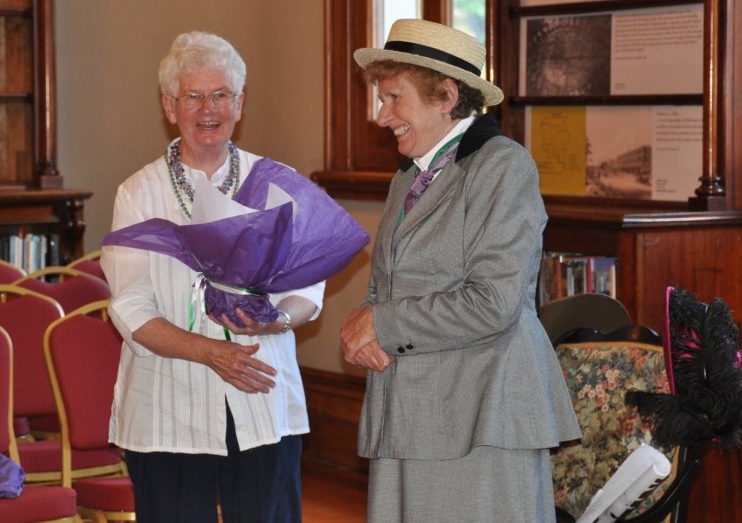
Photo: David Langdon